Those who don’t know what Apophis
[1] is, It is an asteroid that can potentially do massive damage in the year of 2029. All the major space agencies of the world are concerned about the damage it can eventually do.
[Context : Egyptians used to believe that a mythological beast that represent chaos and darkness and is the enemy of their god Sun will end this world someday. And the name of that beast was Apophis.]
Asteroids once ended the life of dinosaurs on earth, triggering an extinction level event that still haunts many people.
Now, Apophis which is a near-Earth object (NEO) and it is believed that this may reach Earth in April 2029. The size of the asteroid is 1100 feet or 335 metres in size, NASA confirmed.
The average distance between the Earth and the Moon is 239,000 miles and NASA reports that the asteroid will be just 38,012 KM or 23,619 miles away from the Earth on April 9, 2029. Hence, it would be 10 times closer than the moon, and moving with a speed of 29.98 KM per second.
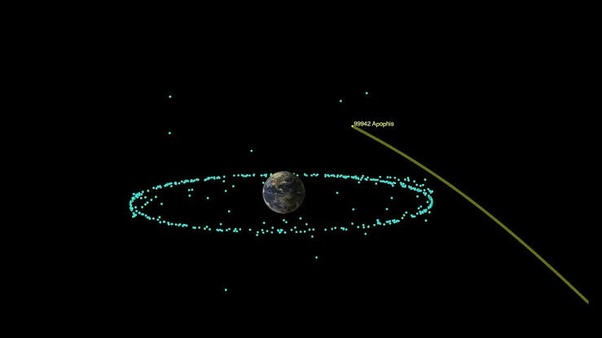
(A visual representation)
According to various reports, the asteroid is currently expected to not do any damage to our mother planet, it will just be uncomfortably close.
If it hit, Apophis would release energy equivalent to more than 1,000 megatons of TNT if it hit Earth, which could devastate an area up to several hundred kilometers from the impact site. This would likely kill millions of people in the affected region. However, it would not threaten the entire human population.
The asteroid that led to the extinction of the dinosaurs was at least 10-15 kilometers wide, much larger than Apophis. An asteroid that size would be capable of causing widespread, global destruction. In contrast, while an Apophis impact would be catastrophic, it would not lead to the extinction of humanity.
But we have to be ready for everything and so, space agencies have started preparing for the worst case scenario. NASA will do everything they can specially their DART Mission.
9 April 2029 – Mark this date somewhere!
And, the asteroid is expected to be close to mother earth again in 2036 and 2068, but the expected closest position will be in 2029.
Depending on where it hit, it could cause very significant damage over a very wide area and potentially result in the death of millions of people.
Current estimates are that in 2029 and 2068 there’s just a 1 in 150,000 chance of it hitting Earth, although at an estimated distance of just 20,000 miles, it will pass by close enough to be visible with the naked eye.
One of the problems with calculating the orbit of objects such as Apophis is their irregular shape, which can lead to a variance in solar heating and the consequential effects of offgassing producing minute changes in their orbit. These effects in themselves are tiny, but over time and distance they can add up, however the more observations that are made, the more accurate the orbital predictions become.
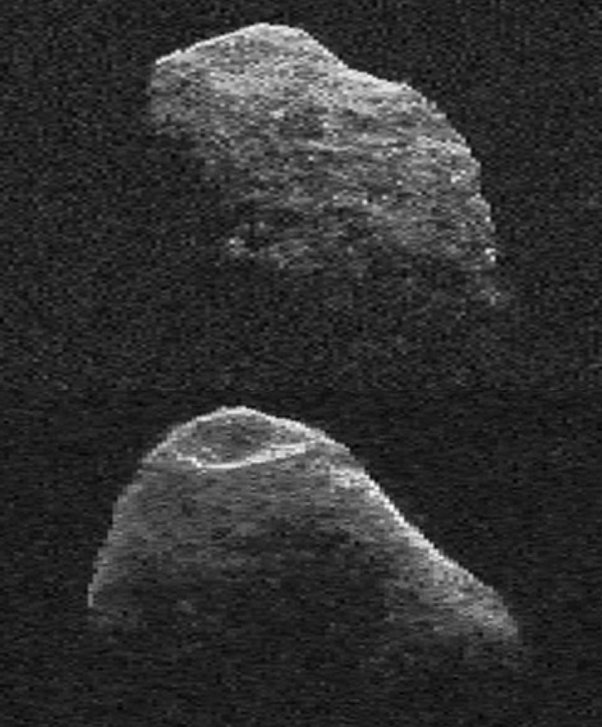
Apophis. Image courtesy of NASA/JPL
But Apophis has a mass estimated to be just 0.001% of the dinosaur-killing asteroid of 65 million years ago, so it poses no extinction threat whatsoever, although if it hit land it’s likely to make a crater around 5 kilometres (3 miles) across, nearly 5 times larger than the Barringer Crater in Arizona.
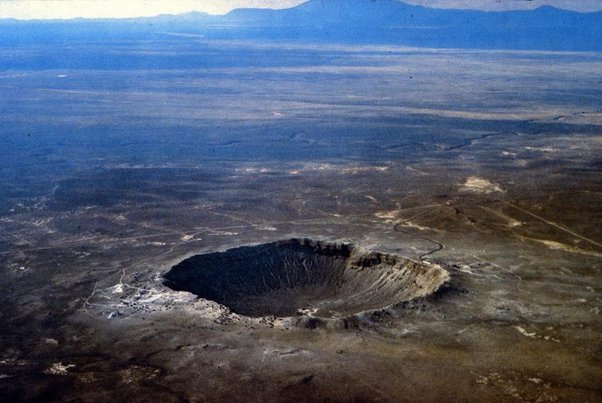
Obviously, if this was in a densely populated metropolitan area, and it wasn’t possible to evacuate the population, the death toll could be enormous, however, if it hit in the middle of the Atlantic or Pacific Ocean there would certainly be a large tsunami which would reach the coasts of surrounding countries, however the damage and potential loss of life would be greatly diminished.
But no, no extinction event, and possible temporary climatic changes from dust or water vapour thrown up into the atmosphere apart, life for the rest of the world outside the immediate impact region would carry on much as normal.