“Half-life” means “half of the atoms have decayed after this time”.
So a very long half-life means that the atoms rarely decay – meaning that it’s not actually very radioactive! You can actually handle uranium quite safely, as long as you don’t breathe in any uranium dust; it’s toxic, so I absolutely don’t recommend it, but the toxic effects are far more dangerous than the radioactivity.
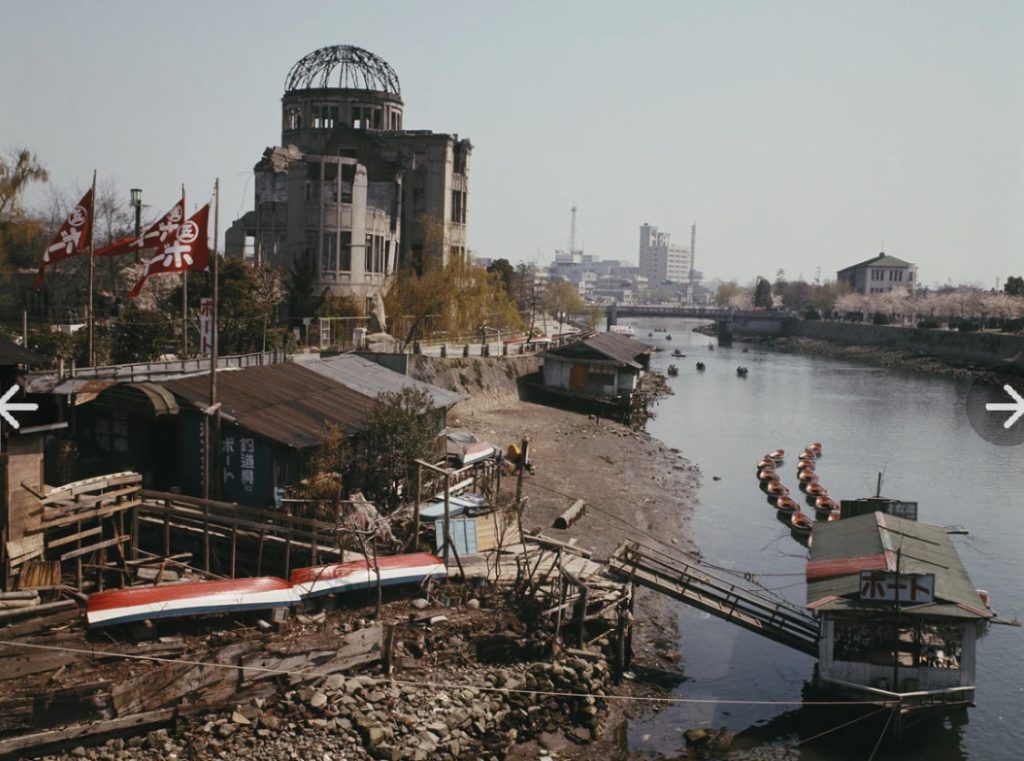
The dangerous stuff that can render a place uninhabitable is something like caesium-137, which has a half-life of 30 years. The area around Chernobyl is full of that kind of material. In Hiroshima, you would have had some caesium-137 immediately after the explosion, but A) it settles on the ground and they actually cleaned the city afterwards, B) by now, only 15% of the radiation remains. (Also, the bomb used was very small by later standards – about 0.4% of the yield of the currently biggest bombs.)
The immediate fallout of a nuclear explosion contains extremely dangerous isotopes with very short half-lives – and they are dangerous precisely because they have such short half-lives, which means they are extremely radioactive. That’s why you are advised to stay in shelter for at least 48 hours after a nuclear attack: after that, the most dangerous material will have decayed to somewhat safer levels so that you can get out of the fallout zone.
Because the half life of U235 is 700 million years.
Think about it. Assume that half* the uranium was split during the chain reaction, leaving the other half to just be extra uranium that settled into the ground. [Edit, in fact, it was more like 2 percent that fissioned, with 98% left over.]
That gives you well short* of a megaton worth of energy, to be released over 700 million years and distributed over a region of at least 100 square kilometers. [Edit, the yield of the bomb itself was more like 10 or 20 kilotons, but since most of the U235 did not fission then and there, we have to multiply by 50 or so to get the energy that will eventually be released. So it’s not as “well short” of a megaton of latent energy left to consider as I had originally thought. It is, though, at worst in the vicinity of 1 megaton.]
So how much energy is released per square meter per year? We gave ourselves 4E15 joules, which is one megaton. That was very generous. But we have to divide by 7E8 for starters, to get the yearly release. That takes us to about 6E6 joules per year. Now we divide by 100 to get 6E4 joules per square kilometer, and then by E6 to get 6E(-2) joules per square meter per year.
Sunlight reaching the surface comes to a few hundred joules per second. So you’re getting ballpark a thousand times as much sunlight per second as you’re getting radioactive release of energy from uranium decay per year. Some nontrivial fraction of that sunlight is in the UV part of the spectrum. So to simplify, one second in the sun is more likely to give you cancer than one year living in the company of that extra radiation.