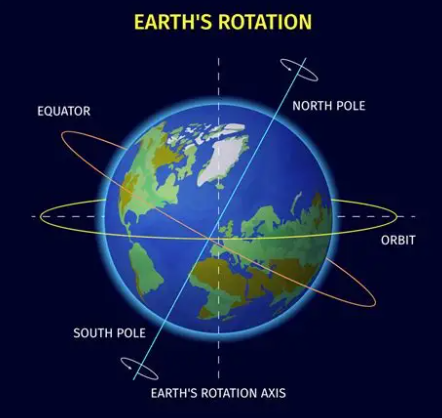
It’s not mysterious at all. Newton predicted it hundreds of years before it could be directly measured. Basically, the Earth is slowing down because the Earth spins “beneath” the Moon faster than the Moon revolves around it.
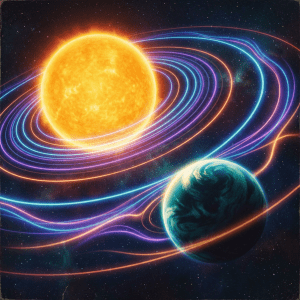
The Moon’s gravity creates a tidal bulge on the Earth. This bulge attempts to rotate at the same speed as the rest of the planet. As it moves “ahead” of the Moon, the Moon attempts to pull it back. This slows the Earth’s rotation down.
One of the rules of the Universe is that “angular momentum” can’t go anywhere — even if individual pieces speed up, slow down, or change direction, the sum total of angular momentum cannot change. The Earth loses angular momentum when the Moon slows it down, so the Moon has to gain it — and it does, by moving further away in its orbit. The Moon is currently receding from the Earth by about one and a half inches per year.
Exactly the opposite thing is happening to Mars’ innermost moon, Phobos. Phobos revolves around Mars faster than Mars rotates, so Phobos is speeding up Mars’ rotation — and is also slowly spiraling inward as a consequence. As a result, Phobos will crash into Mars in about fifty million years.
ETA: Chris Dybala pointed out through suggested edits that I had gotten the recession rate of the Moon wrong — it’s about one and a half inches per year, not one and a half centimeters. He also suggested changing the amount of time it would take Phobos to crash into Mars to fifty million years, which seems to fit the range I see most often (thirty to fifty), but I’ve seen papers that predict it in as few as ten; there seems to be substantial ambiguity in measuring tides on Mars’ complex crust resulting from such a very tiny rock.