Great question.
Years ago, I asked that exact question to someone at Goodyear Aircraft Tires. I was sure no one else had ever thought about it and I would be hailed as a genius. Goodyear is one of the handful of major suppliers of aircraft tires and my friend there didn’t hesitate to respond, proving there’s rarely any idea that’s truly new (and that older people are remarkably smart!). Here’s his answer as I recall it:
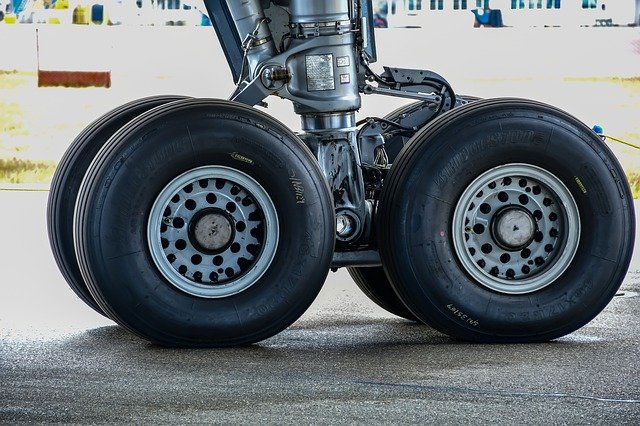
- Airplane tires are very heavy because they have to support the weight of an entire airplane. On top of that, there’s a heavy wheel and the rotating segment of the brake assembly. Getting all that weight spinning to the 150mph or so the airplane is traveling when landing would take a LOT of energy—probably much more than you could get from attaching blades to them.
- The blades (or motor) would add unnecessary weight to the airplane. Every pound of weight is a pound of cargo or passengers that can’t be carried. It would also be one more thing to require maintenance.
- The “chirp” and puff of smoke the tires make when landing is a bit of rubber burning off. That unbalances the tire slightly, but since the tires are free to rotate when landing, the light side spins to the top and the heavy side is on the bottom such that each subsequent landing burns off a bit of rubber on the heavy side. It’s sort of a self-correcting system.
- The theoretical benefits of spinning up the tires in reducing wear would be minimal at best and the costs/disadvantages would more than offset any benefit.
There might have been a couple of other elements to his answer, but the conversation was about 20 years ago.
I recently spoke to another friend who has worked in Goodyear’s aerospace division for many years. I mentioned this post and all the responses I’d gotten to it. He said that the bulk of the wear on aircraft tires is during taxiing, not landing.
I thought that additional nugget might be interesting. Also, for those suggesting the tire companies are intentionally ignoring the “spin-up” solution because it would make the tires last longer and reduce sales, I would add this. The tire companies don’t operate in a vacuum. There are four major new tire suppliers to the aerospace industry: Goodyear, Michelin (formerly BF Goodrich), Bridgestone, and Dunlop. They compete pretty hard for airline and other aviation tire business.
One of the chief factors in tire choice is the projected number of landings (along with price, number of retreads, fleet applications, etc). If the tire companies could gain a significant competitive edge by adding vanes to the tires to extend airline tire life, they’d seriously consider it.
They’d have to balance that “edge” with the incremental cost to develop the vanes, gain regulator qualification, and replace the very expensive tire molds. Those actions would cost a LOT of money and would increase the tire cost and/or reduce the profit. My guess is the business case would not justify it.