Planets do not have to rotate. Look at Venus. It rotates so slowly that it might as well not be rotating. It rotates backward as well. You might think of it as a negative rotation. Therefore, zero rotation is an option for any planet.
Most planets do rotate and rotate in a forward (same direction as revolution) direction. This is all due to the conservation of angular momentum. (Look them up if you don’t know these terms.) This is expected from modeling of the solar system development. However, the chaos of planet formation can result in a different rotation, even near to zero.
Why doesn’t it stop?
If you put a toy top out in space away from any serious stuff in that near-vacuum and spin it, you could go away and come back years later to see it still spinning at essentially the same speed. This means that it still has the same rotational energy.
If you did the same thing inside the ISS, you’d find that it had stopped. Its rotational energy would have been sapped by friction from the air, by the collisions with air molecules.
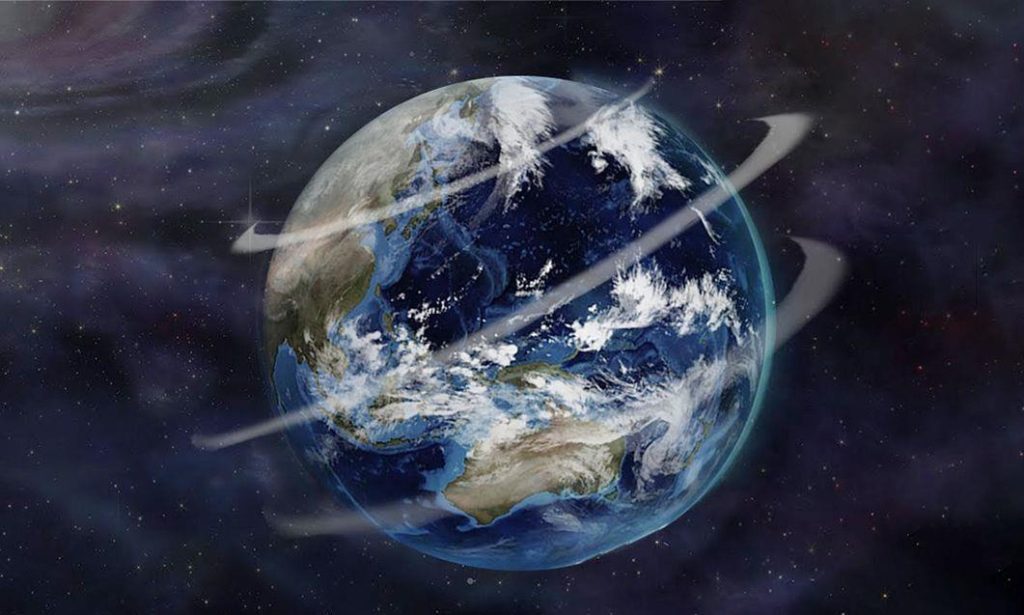
The Earth is like that top, and its rotational speed is decreasing ever so slowly from factors such as the Moon capturing some of its angular momentum and the solar wind creating friction.
The exact length of a day 4 billion years ago is not known, but estimates peg it to around one-quarter of today’s day. In another 4 billion years, it may be twice as long — again, we cannot figure it out exactly due to too many unknown future factors being involved.
It will stop when the Sun swallows it up in 4–5 billion years.
An object in motion will stay in motion unless acted upon by an outside force.
So if an object is rotating, it will continue to rotate forever, unless something makes it stop.
So why would you expect that a rotating object will stop on its own? Because in your day to day experience things don’t keep rotating forever. Spinning tops tip over, rolling wheels slow down, golf balls roll to a stop.
But this is because all those objects are being acted on by outside forces, like friction. But there is no friction acting on the rotating earth as it spins in space.
So the Earth will rotate forever. Except there is one tiny source of friction, the tidal forces exerted by the sun and moon. Eventually the earth would stop spinning and always have one side facing the moon. However this will take billions of years, and long before that happens the sun will swell up into a red giant.
The expanding sin will exert a force on the Earth, and it will be destroyed as a separate object and add some trace contaminants to the remains of the sun.