Here’s the Harry S Truman doing UNREP in the Ionian Sea:
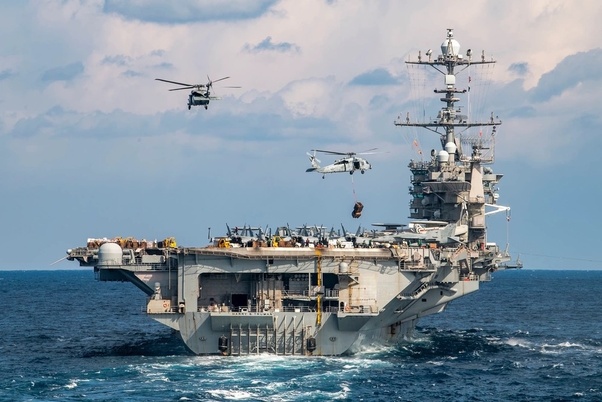
See that big thing sticking up on the starboard side? That’s the main reason why the Nimitz class has an inherent starboard list, along with pretty much every other carrier with a starboard side island. (Truman seems to have a starboard list here, but that might be an illusion because of the mass of the island, or because the camera angle isn’t from dead astern, so I can’t say for sure.)
So how do you deal with that? Usually ballasting the port side (most common, usually a combination of fixed and liquid ballasting), juggling fuel from starboard to port (although the Nimitzs’ ability to do this is more limited than older carriers), trying to keep stores more to port, and so on. A few carriers (e.g., USS Wasp CV-7) were designed with asymmetric hulls to give a little more buoyancy to starboard, but that’s not ideal hydrodynamically.
The Japanese carriers Akagi and Hiryu had port side islands that balanced their starboard side funnels and didn’t have this problem, although they had other issues, like more difficult landings. (Clarification: Counter ballasting was not why those two carriers were built with port side islands.)
Probably one of the more extreme cases involved the Independence class CVLs in World War II, which had a disconcerting starboard list when fully loaded that couldn’t be corrected due to the layout of ballast and fuel tanks (these were originally laid down as light cruisers, which didn’t have significant asymmetric loads—one of the disadvantages of conversions).
Their COs had to use starboard side fuel first to balance out the ship because they needed the fuel for range in the Pacific and couldn’t just load the starboard tanks less.
So a having a starboard list (with a starboard island) is typical for a carrier, and there are ways to deal with it.