I visited the various messes daily when I was on duty, whether at sea or in port. I never visited during meal times. This would have required everyone to sit at attention for a moment when I entered. It would have been majorly disruptive. I came before or after meals and I would stay just long enough to ask if everything was alright and to quickly eyeball the condition of the mess. I would leave in under a minute.
I don’t recall ever being asked to join them in a meal, unless it was a simple courtesy. And in those circumstances, I would politely decline saying I had pressing matters elsewhere, plus the Wardroom steward was probably keeping something warm (or cold) for me when I had a few minutes to sit down and eat.
Furthermore, the stokers who I worked with daily, saw enough of me during watches that we had time to chat then about whatever they wanted (leave, pay, promotion, getting on a career course or maybe even the dive course, spouse problems, money problems, homesickness, illness in the family, newborns, dogs, cats, etc…)
I can only recall eating with my divers at the dive site, often out of Hay boxes, and I always ate last. Unless they were mad at me, someone would clear a space for me to sit and eat with them. Occasionally the Petty Officer or Chief would ask to eat with me apart from the divers. This was usually a very important leadership discussion.
At sea, at meal times, I had just enough time to join my fellow officers at the dining table in the Wardroom, have quick chat with the Executive Officer (the Engineer sits on the right hand of the XO in the RCN), give my food and beverage order to the steward when it was my turn, update my fellow officers on anything of importance (engineering is always important but not always important to non-engineers), coordinate something with a fellow officer that needed face-to-face agreement, and then eat my dessert and drink a quick coffee before returning to my duties.
If I had done this in the crews mess, it might have been held to be unseemly, hasty and possibly rude. None of my fellow officers sat around much during the working day, except maybe the Doctor and maybe the pilots if there was no flying going on.
There are BIG differences between the services in this, and I mean the cultural gap is huge.
The American Navy descended almost directly from the British Navy and is hugely class-conscious. Officers and enlisted don’t mix. Officers, speak to chiefs and chiefs direct the men. There aren’t just two different messes, there are three — officers, senior enlisted and junior enlisted.
There is a reason for everything that persists. Life is very fragile on a ship—take a nuclear submarine: a wrong move kills everyone aboard. Familiarity breeds contempt. Better to let the Captain remain a godlike figure rather than Fred who likes knitting to relieve stress. A little psychological distance is a good thing.
The Army was heavily influenced by the proto-Germans (Prussians) and the French— a lot more egalitarian than the Navy, but still conscious of rank.
We eat together in the field, there is only one mess hall, though we may be at separate tables. There was only one mess hall in Iraq — Generals and Privates ate in the same space.
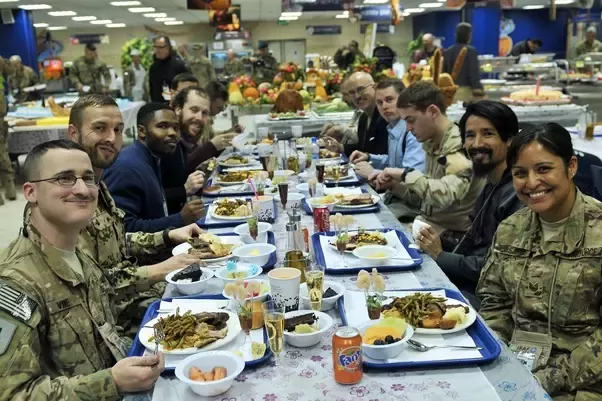
The Air Force is directly descended from the army, and the least rank conscious part of the army, aviation. Their enlisted are smart, they are technicians, and they keep the planes in the air. The Air Force uniforms are more egalitarian, I do not think there is any problem with an air crew sitting and eating together in the air force.
So I think you need to calibrate your expectations to the service you are discussing.
I’m going to answer this from the perspective of a Naval Officer, more specifically a line officer, which nearly every officer except non-warfare specialists are. I’ll begin with a few questions:
- Why are the Navy ranks so different for officers than for the other DOD services?
- Why would you want separation?
Second one first. You know that officers are people too, right? We like to bitch just as much as everyone on board. But there are filters going down rank where you don’t bitch in front of them. If we get extended on deployment, you don’t think I want to tear my hair out?
But I have to be the face of the squadron to the sailors in my department, so I filter my own personal feelings about matters. Sitting around a mess table is one of the few times we feel relaxed enough to release some steam.
And for the enlisted folk, it’s the exact same thing: they need somewhere to release as well. Do you want your boss sitting next to you during some of your only free time? Separation allows us to be real humans for a short time.
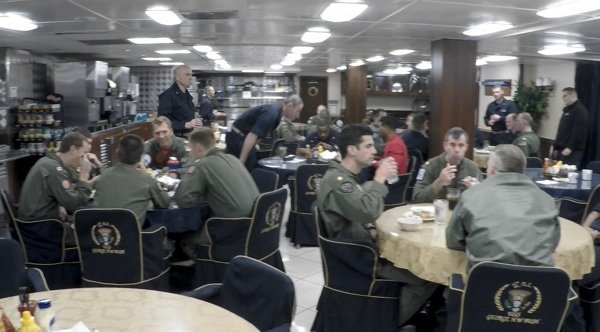
It’s all cafeteria style but it hits the spot…on a CVN anyway
First one second. Our ranks are inherited from our British past, and that past is from the age of sail. The Captain and his mates had to maintain discipline under extraordinary circumstances and their strategy was to establish strict observance of rank. But more importantly, you have to understand from where the crew originated.
It was clearly a class thing. Lords and their ilk obtained commissions as officers from the crown and couldn’t be expected to dine with the laborers. That is NOT how we feel now but the tradition of dining separately remains.
I will say that when I was forward deployed to Iraq, the dining halls were all intermixed and we had absolutely no issue with it…why would we? The only time I “pulled rank” was when I joked with the PVT in front of me that he better not take that last garlic Parmesan wing. He left it for me and I feel terrible to this day that he didn’t get that wing…or not. It was really tasty.
Edit 1: There seems to be some angst about my characterization of the Royal Navy (RN). Claims of obtaining a commission through merit are indeed true, but only after a guy named Samuel Pepys came along and reformed the Admiralty in the 1670’s.
In an effort to professionalize the officer corps, he introduced a bunch of rules and reforms to reduce the corruption within the ranks of the RN officers. One of those reforms was the introduction of oral exams administered by a board of captains and the prohibition of directly paying for a commission.
That’s all true but the tradition of dining separately as officers significantly predates these reforms. And it didn’t change after.