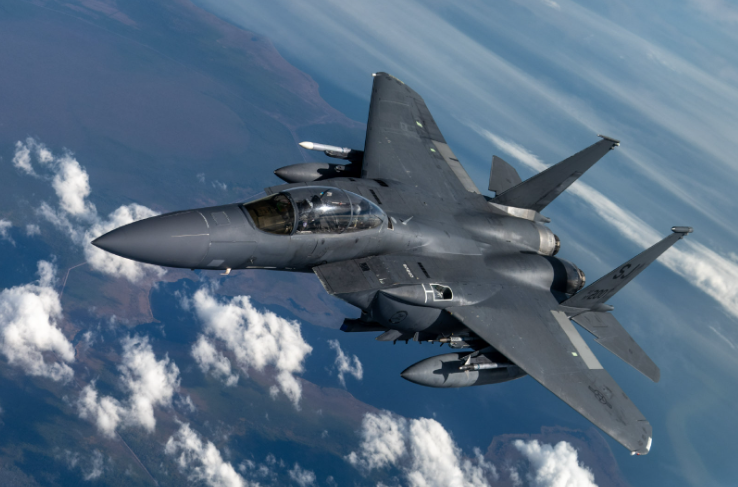
We had an F-14 pilot on an exchange tour in my F-15 wing back in the mid 1980s. I would be willing to bet that in an emergency (and with an Air Wing commander crazy enough to let him try it) that guy could have successfully pulled it off. However, the problem is, the aircraft couldn’t do it day in and day out without the modifications specified in some of the other answers.
In other words, I don’t think one trap (landing) would rip out the innards of the aircraft like a honeybee leaving its stinger behind, but it would happen eventually, if you kept doing it.
Back in the 1970s, a Forward Air Controller (FAC) told me that all USAF FACs had to be carrier qualified (they flew small prop-jobs in those days, so the only challenge was probably in catching up to the carrier…) Other than the practice implied in the FAC’s claim, I can’t think of an instance when a fixed-wing Air Force aircraft has landed on a carrier. And even in an emergency, I don’t think either side would go for it.
There are always better options available.
It takes an aircraft with special structural designs to withstand the forces of a carrier landing. The fuselage and landing gear in particular, require extensive strengthening such that a major redesign is necessary from land-based aircraft such as the F-15.
There are lots of other design features that Naval aircraft need (launch bar for catapults, wing/flap design for lower landing speeds to accommodate the arresting cables and engines, rapid engine response in the landing speed/configuration, somewhat different electronics, extra anti-corrosion features, and so on.).
But the primary answer to your question is that the F-15 airframe is not designed to with stand the forces of a carrier landing. The landing gear would fail, and fueselage would likely bend/break. Not to mention that the “emergency brake failure” hook on the F-15 would rip right off, taking some of the rear empennage with it. Ugh…
Sometimes, it’s a wee bit rough on the landing.