Let’s start with the worst:
Unfortunately, some stereotypes might be true. When I served in the German army we trained for a week with Italy’s famous “Folgore” parachute unit. Although they were considered elite in Italy, they really sucked.
When we went with them to the shooting range my job was to count the targets they were hitting, which weren’t many. With one guy it took me a while to figure out that he was missing his target by at least 5 meters- at a 150 meters shooting distance.
These guys failed at everything they did, except for one thing: The last night of their stay we went to a bar with them and after a few German beers they started singing Italian songs. Very well and beautiful and not like our “barbaric” German singing.
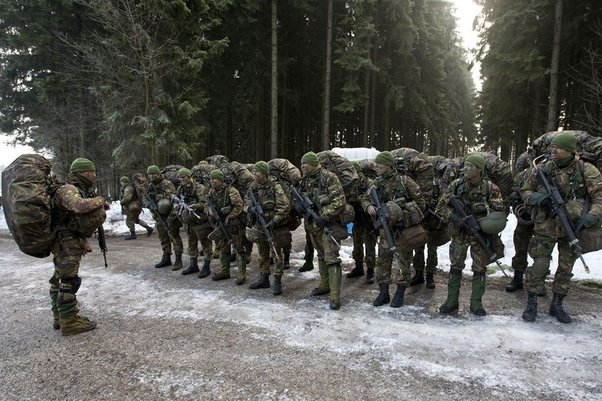
Dutch Korps Commandotroepen (KCT)
I also trained a lot with French units. Most of them were really decent fellows, but their officers were completely useless. They were unable to motivate their soldiers and always seemed to be screaming at them. As a result the French troops we trained with didn’t perform as well as they could have.
Although I trained with British troops on several occasions, they didn’t leave an impression with me. Neither good nor bad. Later on my German army unit got their a** kicked by a British Special Air Service unit during an exercise in Denmark. I didn’t participate in this exercise and therefore these SAS guys are not in my ranking.
In Bosnia I fought for the Croats. They were all decent soldiers and what is very important, they were eager to learn. The Croatian army during the war lacked material and sometimes professionalism, but they more than compensated these flaws with outstanding bravery and high motivation. Especially their leadership was exemplary.
Later I fought in Kosovo with the Kosovo Liberation Army. I trained the unit that I fought with, so of course, they did ok. What I often saw in battle was that with the right guidance one could really make a difference. Sometimes we had soldiers from other units under our command and although we first thought that they were completely useless, watching our guys fight it out, these soldiers started to give their best.
I trained twice with US Army units and both times it was a pleasure. First time with a battalion of the 82nd Airborne in Italy and later I had the privilege to attend the German commando course with a US Army Special Forces unit. While the Airborne soldiers, although very good soldiers, were not really a match to our German “Fallschirmjäger” platoon, the US Army Special Forces (SF) were amazing.
They somehow weren’t that good at achieving many tasks during our training inside the barracks and were also not the fastest team on the obstacle course, but as soon as they were in the forest they showed admirable infantry skills, very good adaptation to the terrain, speed and stealth.
These SF would make the first place on my ranking if it wasn’t for a couple of Dutch LRRP’s (Long Range Reconnaissance Patrol) soldiers who also attended the same German commando course. They were good at everything and in the end had the highest score from all attendees.
They were also very modest, quiet and polite, almost shy, and these are qualities one doesn’t find very often with elite soldiers. Therefore I rank them first.
I was in the US Army from 1984–1996, and spent most of that time in Europe, with but one stateside assignment (Ft Ord). In that time, I worked with Canadians, Brits, Aussies, Germans, Dutch, French and Saudis in both war and peacetime exercises, and frankly, except for the Saudis, all had their good points, and bad points too (except the Saudis were universally bad).
As an Intelligence Analyst, my assignments were always at HQ, whether, Battalion or higher, so I had a pretty good view of the ‘results’ of the professionalism and skill of these different troops, as well as working alongside at whatever TOC or TAC I was part of.
It is hard to rate the relative merits of these troops, because it is hard to ‘generalize.’ Each army has their own ‘specialties,’ and special attributes within specific units. For instance, though I was not particularly impressed with the French army overall, the Foreign Legion and its Legionaires are another matter entirely, and I would put them up against pretty much anyone else in most scenarios.
The Brits I found to be universally good, professional, and ready to ‘do the business,’ and some of their units were just outstanding (SAS, etc.). I worked very closely with their Intel folks, as well as the tankers of the 1st Armoured Division (‘Desert Rats’) in Desert Storm, and as all of us at the time were trained to the height of Cold War readiness in Germany for years, we got along very well and with seamless interoperability which was demonstrated when we all went ‘over the top’ into Iraq.
This was also a consistent strength during the Bosnian war, as I was teleconferencing with the British UNPROFOR commander, General Rose on a weekly basis, and the general ‘esprit d’corps’ of all involved in the ‘special relationship’ between us and GCHQ was likewise outstanding. You could always trust the Brits implicitly that we were always ‘on the same side,’ and their abilities to obtain HUMINT was remarkable to say the least.
The Germans at that time were particularly good at armored reconnaissance, and this was demonstrated to me many times during REFORGER and other exercises (they would just ‘show up’ and drive quickly through your camouflaged TOC in the middle of the woods, firing blanks all over the place without warning). But their armor tactics hadn’t essentially changed much since WW2, and that made them quite predictable if you knew what to look for.
Same thing with the Dutch armored forces, and because of it, we handed them quite a spanking during an exercise called ‘Free Lion,’ the last of the big NATO Cold War exercises. Of course in those days, both the Dutch and German armies were manned by conscripts, and that doesn’t lend itself to a lot of ‘professionalism’ outside of the various ‘elite’ units.
The Canadians were like the Brits in many ways, but their lack of modern equipment was pretty embarrassing for them at all times. The Aussies can’t be considered as anything but TOUGH soldiers, but if you value your brain cells, never try drinking with them.
I think of all the different national armies I have worked with, I would have to rate the British Army as the best overall, outside the US military (at least, that was the case ‘back in the day’).