Knowledge

Where exactly is Voyager 1?

This is a topic of great interest to me, especially since Voyager 1 is the most remote craft we have ever sent forth.

After 40 years of travel, it has reached the light distance of only 20 hours. In evaluating this result, it tends to place a large damper on our ultimate ability to reach anywhere that is significantly outside the solar system.
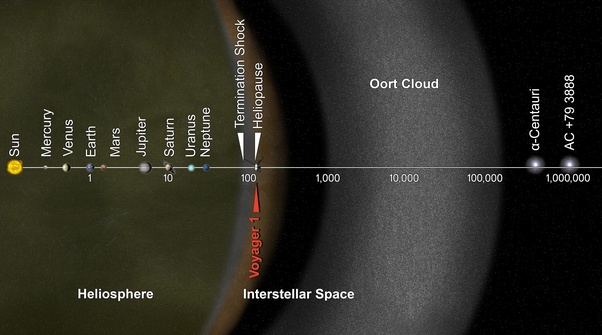
This graphic (which represents a logarithmic scale, based on AU) was created in 2013, and so Voyager is ever so slightly more to the right. Voyager is estimated to reach the Oort cloud in about 300 more years.

It will be many generations of us to come and go, before Voyager, then dark and cold, reaches the Proxima Centauri or Alpha Centauri neighborhood.

We have to work on the next generation (or two) of propulsion, otherwise we are restricted to the Solar System.

Update: As of 2 March 2021, Voyager 1 has traveled a distance of 21 light hours 5 light minutes and 35 light seconds away from the Earth; its velocity (with respect to the Sun) is 38,026.77 miles per hour (16.995 km/s).

This (the white circle) is where Voyager 1 is now, courtesy of the New Horizons spacecraft, which itself is 50 AU from Earth. Courtesy of NASA
Related Posts

Do submarines still have a big advantage over ships in war, or can ships find them and launch smart guided torpedoes from a safe distance?

During the time I served, if you asked a submariner what kind of ships did the Navy have, they would usually reply: submarines and targets. During one particular…

Is it better to inflate the tires a little more than recommended?

Will it make the tires last much longer? Why was I told this? Will it also make your tires more prone to blowing up if they are older…

Why do PCs gradually get slower with usage?

There’s 4 main reason for this, but only 2 of them are genuinely noticeable unless it’s a severe case of the latter reasons. Here are they by rank…

Do submarines hit things in the water?

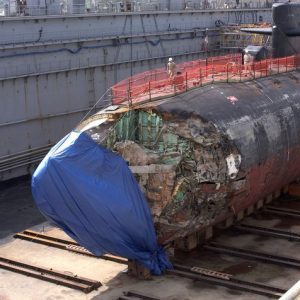
Yes they do. There have been reports of submarines hitting whales, surface ships, and other submarines. Here’s a photo of the Los Angeles class USS San Francisco after…

Can U.S. aircraft carriers get bigger? Say 75 percent or two times bigger and than they are today as well as require less manpower to operate them? What are the pros and cons of this?

Can they? As in, is it theoretically possible with current engineering? Sure. Should they is another matter, and the answer to that is definitely no. If you look at the…

Why do some aircraft like the TU-95 and B-52 outlast newer planes? What features make them so adaptable over the years?

Just because they are big. Let me explain. Nowadays, the role of a strategic bomber is obsolete, as these big flying clunks are really easy prey for modern…