Once, as a British ship passed an American ship, the Americans signalled to the British, “How’s the world’s second largest navy?” The Royal Navy replied, “Fine. How’s the world’s second best?”
Anon
The US surpassed the Royal Navy in size in late 1943 or early 1944, assuming that we do not include the Royal Canadian Navy (RCN) or ships belonging the RAN, RNZN or to the RIN (Royal Indian Navy) which supplemented the Royal Navy. Therefore, this comparison is between Britain’s Royal Navy and the USN rather than the British Empire navies and the USN.
In 1939 Great Britain deployed 332 vessels versus the US Navy’s 241. The Royal Navy led in all classes including carriers.
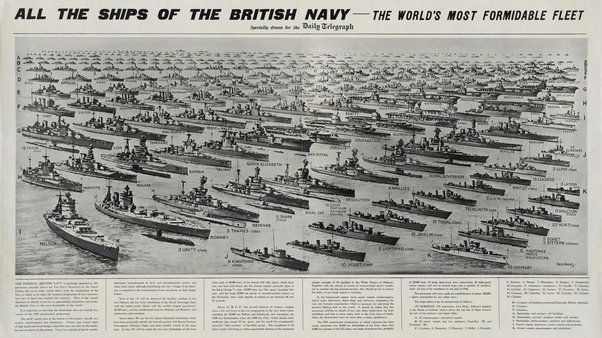
By the end of the war, the US Navy deployed around 6,800 vessels and the Royal Navy some 4,800. Due to its massive wartime shipbuilding programme the USN nearly tripled in size between the end of 1942 and the end of 1944, and by 1945 was nearly six times larger than it had been in 1938.
The vast bulk of the US Navy vessels, some 5,500 odd, were mine warfare, amphibious ships, auxiliaries and other smaller surface warships. Due to the special requirements of the Pacific Campaign, by 1945 there were 2,547 amphibious vessels and 1,267 auxiliaries (transports) alone. If we restrict ourselves to looking at what most people might think of as naval ships, that is to say surface combatants of frigate size or above, a slightly more nuanced picture emerges.
By VJ Day, the Royal Navy is deploying 885 vessels and the USN 1,164. The clear difference is obviously in carriers with the USN deploying 99 as opposed to the Royal Navy’s 65 (with many escort carriers being built in the US) and in Destroyers/DE/Frigates with the USN deploying 738 as opposed to the Royal Navy’s 461. However, I am not entirely clear whether these figures include the 205 Royal Navy frigates of the River, Loch, and Bay classes. I have assumed that they do.
As previously mentioned, there were also 269 corvettes in British/Canadian service which aren’t included in these figures and which would bring the totals closer to parity (as would removing frigates) it just depends where you decide to draw the line. It shouldn’t be forgotten that, by the end of the war, the Canadian Navy was the third largest in the World with 1,140 vessels including two carriers, two cruisers, forty-three destroyers, sixty-nine frigates, and one hundred and twenty three corvettes.
Therefore in 1939, the Royal Navy had a 38% advantage over the USN whilst, by 1945 the USN had a 32% advantage over the Royal Navy.
Over the course of the war (which was obviously two years longer for the Royal Navy than for the USN) the Royal Navy lost 278 vessels (still frigate or above) or 31% of its final strength, whilst the USN lost 171 vessels or 21% of its final strength.
As for the British reaction, I think that it was pragmatic rather than resentful.
In 1899, Great Britain implemented the Two-Power Standard, committing itself to maintain a fleet of battleships at least equal to the combined strength of the next two largest navies – at the time, France and Russia. This policy coincided with Britain’s unprecedented commercial dominance: possessing the largest merchant fleet in history, accounting for nearly 50% of the world’s entire merchant tonnage, and building 80% of all steamships.
However, WW1 left Great Britain more or less bankrupt and it was clear that she could no longer maintain the Two-Power standard. Further, France was now an ally, Germany had no fleet, and Russia was in ruins, so the original impetus was gone.
By the time of the Washington Naval Treaty in 1922, Great Britain was content to maintain a theoretical parity with the USN and superiority over Japan, the most likely emerging threat – although it’s always worth remembering that Japan was an ally in WW1 and the Anglo-Japanese Alliance was in force from 1902 to 1923.
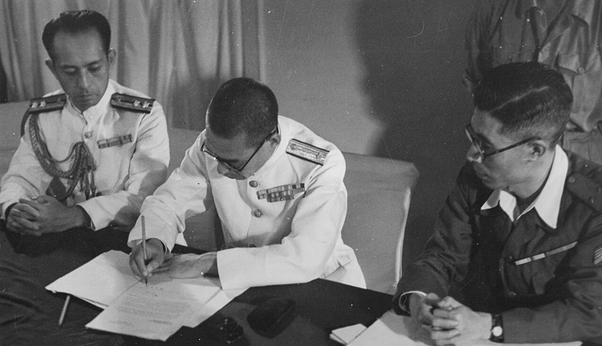
Rear Admiral Uozumi signs the surrender of Penang aboard HMS Nelson in September 1945. Uozumi wears the ribbon of the British Distinguished Service Cross, awarded for his service with the 1st Special Squadron, Imperial Japanese Navy in 1914–15.
If Great Britain was in a poor state after WW1, it was absolutely buggered (a technical term) by the end of WW2 and no longer had either the desire or the ability to maintain a huge navy (although the current state of the Royal Navy is verging on farce). By 1944 it was clear that the post-war maritime order would be American-led in the face of the emerging threat of Communism.
As for the Americans, by 1945, the United States was operating a military-industrial complex on a scale no other nation could rival, and this included the unchallenged status of the US Navy. However, with their traditional inclination toward isolationism, the US assumed the role of global hegemon, replacing the Pax Britannica, with some reluctance.
As there had been no realistic chance of a war between Great Britain and the United States since the War of 1812 (and, yes, I am including the American Civil War in that analysis), and as the two nations were allies, the change in the status of the two navies was not geo-politically competitive. We might see something very different in the new century as powers vie for dominance in the South China Sea.