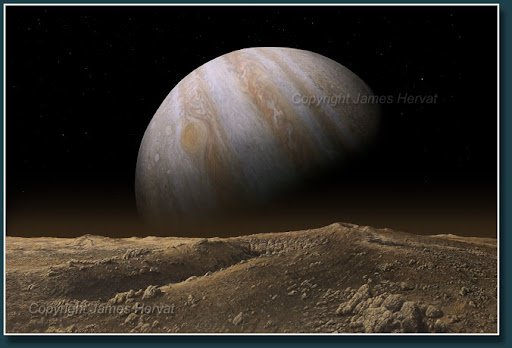
eplace Venus (67 million miles from the sun) with Jupiter, a planet with 390 times the mass of Venus. And roughly 11 times the diameter. Now, you would have an object that is 11 times wider than Venus. At its largest, Venus occupies about 66 seconds of arc in the sky, or 1.1 minutes or 0.018 degrees. In other words, to the naked eye it is essentially a dot. So lets increase by a factor of 11 and you get 660 seconds of arc or 11 minutes or 0.18 degrees. The moon is about 31 arcminutes (about half a degree) on average. So, Jupiter would be about 1/3 the size of the moon. An interesting, but not overwhelming visual spectacle in our sky (It will not appear like the pic by James Hervat that follows).
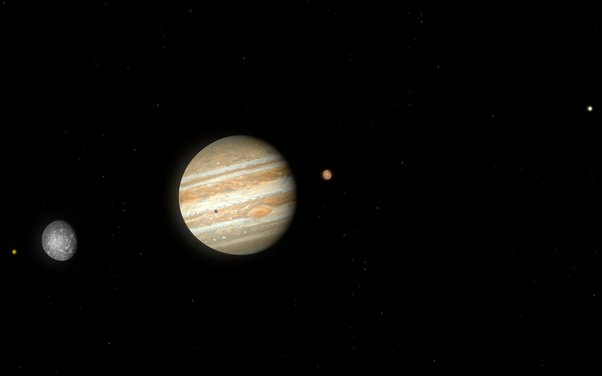
It would be the brightest object outside of the moon in our night sky. It would be more like this, with the larger object (Jupiter in the pic) being the moon and the smaller object to the left being Jupiter in Venus’ orbit. Swap the colors and it would be rather like that.
The more interesting (and I use that word in the Chinese curse sense) aspect is tied to the mass. There would be significant gravitational perturbations. That does not mean the Earth would fall into Jupiter in a year or two, but over many years, it is highly likely the orbit of the earth would be disturbed sufficiently to change from its current sweet spot, either closer, farther or more eccentric with respect to the sun.
Jupiter, as the largest gravity well outside of the sun, also acts to catch things before they get into the inner solar system (think Comet Shoemaker–Levy 9 ). You have just placed the 2nd largest ‘attractor’ in the solar system a whole lot closer to earth. We would probably get additional interaction with objects. Interaction is not always a good thing, particularly if the object is large. And the interaction sometimes involves physical contact. Especially dangerous since things in space are usually incredibly fast moving relative to each other.
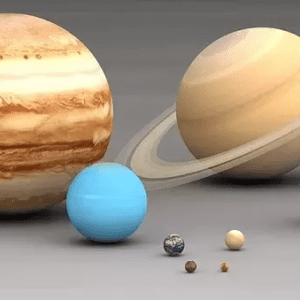
Jupiter’s diameter is 11.2 times larger than Earth.
In other words, you could put 11.2 Earths side-by-side to match the diameter of Jupiter. And Jupiter’s volume is even bigger.
It would take 1321.3 Earths to fill up the volume of Jupiter. The closest possible opposition distance between Earth and Venus is 38 million kilometers. This is the closest that any planet comes to Earth. The farthest that Venus ever gets from Earth is 261 million km.
It is similar to Earth in size and mass, and is often described as Earth’s “sister” or “twin”. The diameter of Venus is 12,103.6 km (7,520.8 mi)—only 638.4 km (396.7 mi) less than Earth’s—and its mass is 81.5% of Earth’s.
Jupiter has a mean radius of 43,440.7 miles (69,911 kilometers), about a tenth that of the sun. However, its rapid rotation — it spins once every 9.8 hours — causes it to bulge at the equator, where the diameter is 88,846 miles (142,984 km). In contrast, the diameter at the poles is only 83,082 miles (133,708 km).
If Jupiter is at location of Venus, It will be closer to Earth by 132,000 kilometers. It is way bigger than Venus. Jupiter will look very big from the Earth, may be bigger than the Moon.