
The galactic core, i.e., the central bulge of the Milky Way, is a region very densely populated by stars. It is a dangerous place. Stars regularly get close enough to each other to disrupt their respective solar systems.
Stellar explosions are not uncommon, spreading radiation across large sections of space, sterilizing planets, killing nascent life. But if you happen upon a planet on which you can stand and look up at night, the sky would likely be quite spectacular, so full of stars you could probably read by starlight alone.
Here is a nice, actual image of the central region of the Milky Way, from Wikipedia:
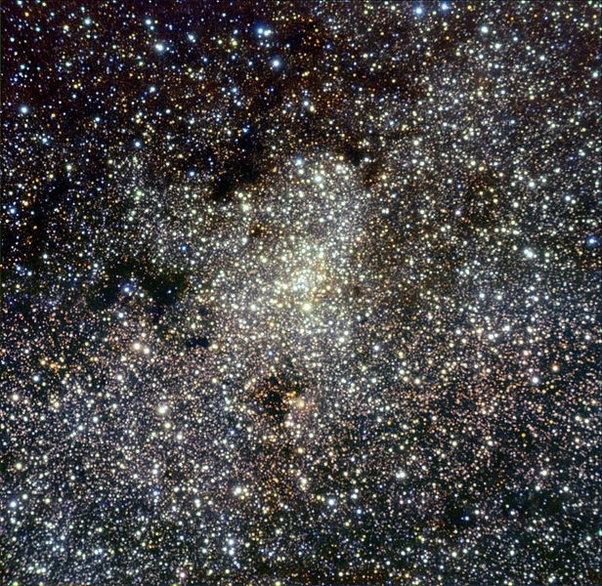
Somewhere in that region lurks the Milky Way’s own supermassive black hole, which caught so many people’s imagination. But contrary to common myths, this supermassive black hole is not the “core of the Milky Way”, nor does its gravity dominate even in the bulge.
Sure, it weighs in at a whopping 4 million Suns, give or take, but the bulge itself weighs on the order of a hundred billion Suns (give or take), completely dwarfing the black hole.
And while 4 million Suns sounds like a great deal, you really need to get quite close (within a few light years) for your trajectory to be seriously affected by this object. There, you encounter stars that orbit this supermassive black hole in tight orbits; the closer they are, the more rapidly they travel.
For instance, there is a star known by its designation, S0–102, which orbits Sgr A* (the abbreviated name of the black hole; the full name is Sagittarius A*) in just 11.5 years. When it is closest to the black hole, it is only about 260 times as far from it as the Earth is from the Sun, and travels at nearly 1% of the speed of light.
But as I said, this region where Sgr A* “rules” is a tiny region of space within the Milky Way bulge, and it does not even necessarily coincide with the Milky Way’s center-of-mass. Elsewhere, you see stars, you see gas, you see rapid star formation, lots of activity that, fortunately, is absent from the region where our own Solar System resides.
But I need to put words like “rapid” or “activity” into context. If you were somehow transported to the Milky Way bulge and stood on the surface of a planet, looking up… you would see nothing “rapid” at all. On human scales, the sky would appear mostly static and unchanging.
If you observed the sky (with an incredible number of stars!) meticulously for years, you might see a few stars move relative to the rest (these would be the stars nearest to you, with large so-called proper motion) but that’s pretty much all of it.
Most of the violent activity that people associate with galactic bulges, with the rare exception of the occasional stellar explosion, take place on time scales that are far beyond human lifetimes.