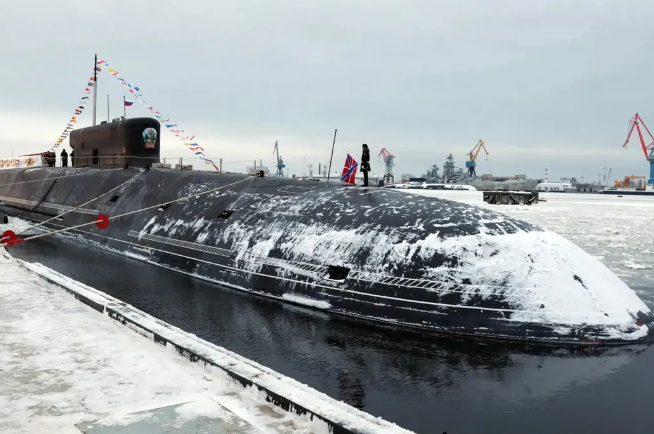
That WAS true, back when the subs were new, especially for the ones with a titanium hull.
The problem with titanium, besides being expensive and VERY difficult to work with, is that every time titanium is compressed, it becomes more brittle. Every time a titanium-hulled sub goes deep, it reduces how deep it can go, next time.
What good is being able to go deep, when you can’t without needing to scrap the boat, next time.
So, why did the Soviets build these small, fast, deep-diving subs? They wanted to be able to evade the West’s best torpedoes. And they could!
They could go so deep, that no torpedo could catch them (a torpedo with a combustion engine that expels the exhaust has a depth limitation, due to exhaust back pressure).
They could go so fast, that no torpedo could catch them, unless it came from in front from a short distance.
But, that didn’t last long. As they say, “A new weapon is only useful until a new countermeasure is developed.”
The US made many substantial upgrades to the MK 48 torpedo (By the way, in America, the only place that uses “MK” it is pronounced “mark” not “em-kay”). They called it the MK 48 ADCAP (MK 48 Advanced Capability, spoken “mark 48 ad-cap”). It could dive deeper than anyone’s greatest desire for a submarine, and had a more than 15 knot speed advantage over the fastest submarine in the world. There were more modifications to the electronics and warhead, too.
And the Brits? They didn’t screw around trying to modify something. They developed an entirely new torpedo, the Spearfish, which is even faster than the Mk 48 ADCAP.
As others have noted, the ability to go deep has advantages of a stronger hull, and the ability to use more of the changing sound velocity with depth. BTW, sound always migrates to the lowest sound velocity, not the highest, and that’s where you want your sensors to be.
Going deeper than the axis of the Deep Sound Channel (also know as SOFA, by some) is only marginally useful, because all of your sound will be bent back up to the axis, where it will be trapped by the shallow edge of the channel, and reflected back down.
That’s why they call it a “channel”. It’s also the depth that large baleen whales (like humpback whales and blue whales) go to, to communicate with each other over hundreds, if not thousands, of miles.
And, shallower, the best depth for an evading submarine is somewhere around the maximum velocity of the thermocline layer, because the sound splits there, and goes both deeper and shallower, causing a shadow zone.
Lastly, there’s a larger safety envelope if you can go deeper.
Safety? Let’s say you’re operating at 400 ft, and your deepest operating depth is 700 ft. If you are going at full or flank speed, and there is a hydraulic casualty, you may end-up with the stern planes jammed at full dive. Just like a jet, you go into a steep dive. It doesn’t take long before you’re passing test depth, and heading for collapse depth. You may never recover.
If, on the other hand, your test depth is 1,400 ft, you can go twice as deep, and have twice as much time to recover, which includes putting the engines in emergency reverse (called “back emergency” in the US Navy). Your odds of survival have multiplied, drastically.
Original question: could Soviet submarines dive deeper than American submarines? Yes, for a while. The titanium ones’ deepest depth kept ratcheting upwards, over time, until they had to be retired. The steel ones lasted longer, but weren’t maintained very well, and also had to be scrapped.
The US is still operating many of the third-generation of sub, and building the fourth generation. The Russians are just getting started on THEIR fourth generation sub, which still isn’t as capable as the US subs.
So, if you ask about NOW, then no submarine in the world is as capable as the latest American sub. Some come damned close, like the Brits, but the US is still ahead. As for potential adversaries? No, they’re all a good ten years behind in technology and metallurgy (and they know it).