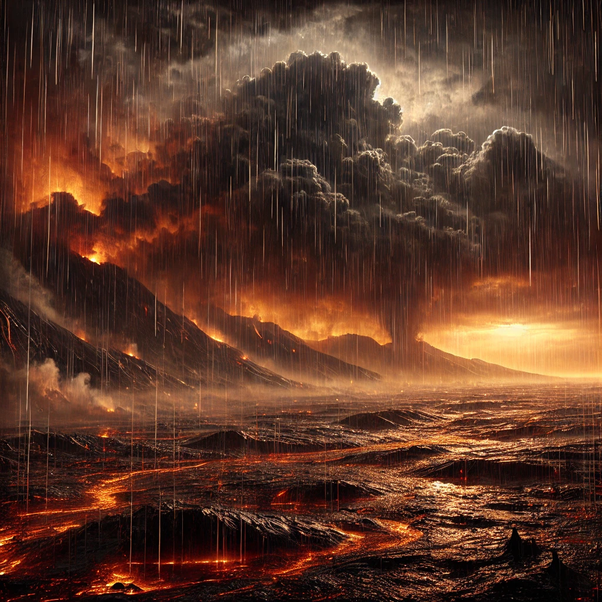
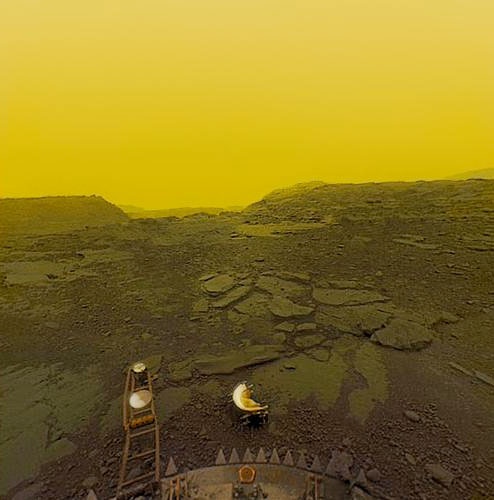
Venus is a hell world which has utterly annihilated everything we’ve ever sent there in minutes. The surface temperature can reach more than 800F (462C). The atmospheric pressure is around 1350 psi (92 bars).
The air is not only aggressively heavy, but also composed of a variety of acids and deadly toxic oxide compounds which would kill in less than a single breath. That’s not even mentioning the incredible, beyond gale force winds which tear across the surface carrying that extremely dense air.
Humans trying to live on Venus would fail. Very quickly. Turning almost instantly into a rather messy jelly. Shortly becoming quite crispy jelly.
Even if we possessed the magical sci fi technology needed to build zeppelin cities floating in the less hot, dense upper atmosphere, the air would still be unbelievably poisonous.
Unless we found absolute proof of some deeply exotic, ultra useful material which only existed in quantity on Venus, there is little reason to ever consider trying to colonize this planet. Mining a totally lifeless astroid in the void of deep space would be easier. Heck, colonizing said astroid would probably be easier.
If there’s a biblical equivalent of hell on any planet in the Solar System, it’s Venus.
Venus will kill you in a gory and disturbing way, spit you back out, fry you in small chunks then regurgitate and grind you into a fine smoothie for dinner.
Aside from having almost the same mass as Earth and being closer than Mars—although technically Mercury is closer, but that’s a debate on orbital mechanics for another day—the similarities between Venus and Earth end there. Compared to Venus, Mars looks like a beach on a tropical island.
Venus holds the record for the highest average temperatures of any planet in the solar system, even though Mercury is closer to the Sun. It’s hot enough to melt lead and destroyed the toughest lander the Soviet Union could throw at it, all under 40 minutes, although it transmitted data for 2 hours. Its atmosphere is so dense that it would crush an astronaut into paste.
Our best sci-fi writers haven’t even imagined a suit that could withstand those conditions, and our top engineers don’t think it’s feasible to design one. The planet rains sulfuric acid and other nasty oxides, accompanied by some of the most powerful hurricane-force winds in the solar system.
If that’s not enough, we’ve recently confirmed Venus is likely the second most volcanically active body in the solar system after Io—a moon being constantly stirred by Jupiter’s gravity. With over 400 constantly erupting volcanoes, Venus recarpets its entire surface in less than 30 million years.
Mars, by comparison, is just Antarctica on steroids; with a sturdy space suit, you could prance around like a deer. But Venus, more “technically habitable” than Mars? Nuh, Venus is a nightmare within a nightmare, cooked in hell.