Yes it absolutely will, but not this year! Sometime, maybe on December 17th, or thereabouts in some undetermined year in the future it will definitely hit Earth and since it is about five kilometres in size, it will make quite a mess.
Bits of it will hit us this year. It is thought to be the source of the Geminid meteor shower, which you can see bombarding Earth if you go outside after midnight on December 14th this year, and every year in mid December.
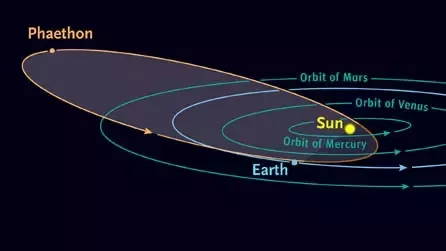
This year the main body of 3200 Phaethon will miss us by about 10 million kilometres. It will come closer to earth on 14 December 2093, when the main body will pass at a distance of 2.9 million kilometres – still about 8 times further than the moon. The orbits of Earth and Phaethon are quite stable and will intersect for a long time into the future. But, its only about every 10 years that Phaethon happens to be in the part of its orbit that is close to Earth in mid December.
NASA has calculated the orbit over a 900 year period starting in 1600. The calculations are available at 3200 Phaethon. According to NASA it won’t hit us in the next 500 years, but beyond that its precise orbit gets more difficult to calculate.
The orbit is quite complex to calculate because besides close approaches to Earth, Phaethon also closely approaches Venus, Mercury and the asteroid 15 Eunomia. Small errors in the calculation could build to a significant change.
Phaethon appears to be inert, but it is suspected of being the nucleus of a comet which has lost its volatiles due to close approaches to the sun.
However if there are any volatiles left, the sun’s heat could cause them to outgas which could also change the orbit.
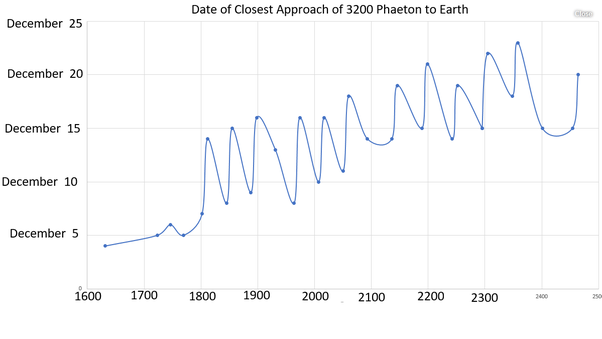
The date of Phaethon’s closest approach to Earth is slowly getting later in the year, as shown in the graph below.
As Ron Davis has pointed out to me, this is due to the precession of Earth’s rotational axis – which makes our calendar year 20 minutes shorter than a complete revolution of Earth around the sun.
Plotting the distance of the closest approaches according to NASA’s calculations, it appears to be getting closer – as shown below.
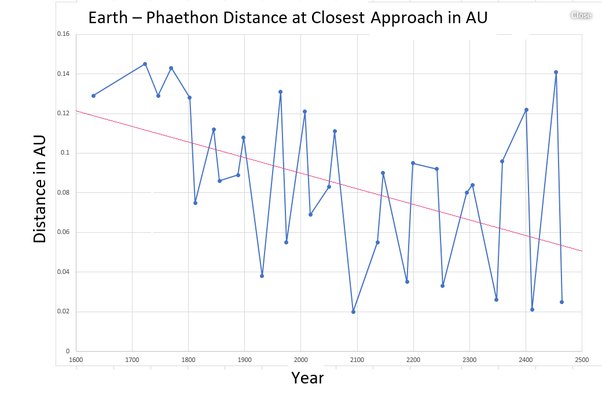
There are many reasons why this apparent correlation could be false, but if it is true, it indicates a collision on 31 December 3223. I am fairly sure that the NASA computationists would dispute my conclusion, but to be on the safe side, perhaps it’s time to start digging a shelter.
Also of note is that during December 2017, according to NASA NEO Earth Close Approaches, there were no fewer than 30 objects which came closer than 3200 Phaethon.
The closest of these was 2017 WV12, a 20 to 40 metre wide object which missed us by 1.6 million kilometres on 9 December.