The world basically starts over. Plenty of life would remain but probably not many humans. Devastation is worse at the equator but pretty bad everywhere. Let’s break it down.
Everything Moves East
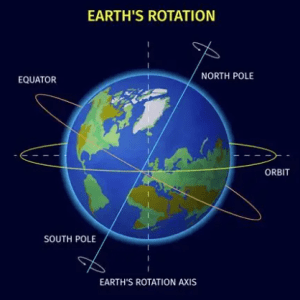
The earth spins on its axis (rotation) once per day causing the equator to move eastward about 1,000 miles per hour. A sudden stop, assuming that whatever crazy thing that stops it only applies to the ground, means everything flies east at its own velocity.
Everything means everything: people, buildings, air, water, even dirt, mud, sand, and anything not directly connected to bedrock. Closer to the poles, the eastward speed drops to nearly zero at the poles. It drops by the cosine of the latitude. Average speed of stuff flying east would probably be around 800 mph, about what it is in the US. So, what does that mean?
Velocity
It’s not just that we travel so quickly, it’s that we actually have velocity, meaning our speed has direction. We travel due east, more like due equatorial east. Looking at the map, everything moves to the right and tangent to the surface of the planet. That means that we travel 800 mph (average) east with the wind and other stuff in our vicinity.
Stuff in the northern hemisphere moves slightly southeast, while stuff in the southern hemisphere moves slightly northeast. Everything falls down, and with only 3 seconds of stopped earth, it falls down about two thirds of a mile away from where it started, give or take.
People and Pets
Anyone underground is dead splattered against whatever wall stands to the east. We can’t handle collisions much over 40 mph, so even an average collision will be similar to a bag of wet cement hitting the wall. Ick. People on the ground don’t really have it any easier.
They’re knocked off their feet and fly east with everything else that isn’t nailed down hitting stuff that is nailed down along the way. People in buildings may fly out eastward facing windows and see the building following close behind, if they’re still conscious. Pets, unfortunately, suffer the same fate.
Water
Lakes, oceans, rivers, and full bathtubs keep moving as well moving east in great tidal waves or tsunamis. That much water, moving unimpeded for three seconds will pretty much wipe whatever didn’t fall down from a mile of the western shores of the body of water. That means that most cities, all coastal towns, and forests would lie bare.
Air
Earth’s atmosphere moves around the planet faster than the planet itself, 1,100 mph at the equator. The sudden stop of the earth’s rotation would cause great winds and stir the atmosphere into massive storms adding to the calamity of the day.
Earth
We already know that dirt, mud, sand and soft stone would move east with all the other stuff, but that’s not all. The sudden change in rotational mechanics would initiate vast lines of earthquakes and volcanic eruptions just about everywhere on the planet at once.
It may appear to an observer in orbit (unaffected by the sudden craziness) that the planet was attempting geologic suicide. With only three seconds of stop, I’d bet the magnetic field (generated by a dynamo effect of the earth’s interior) wouldn’t suffer too much. It may be the catalyst to finally shift north to south.
Restart
After three seconds of hell that kills nearly all animals on the ground, the earth suddenly starts to rotate once again. The same stuff that happened before, now happens in reverse. Everything suddenly shifts westward as the ground moves beneath it grinding everything to a pulp. The tsunamis generated may be more powerful than before dealing greater devastation to the eastern coasts as it returns the detritus from the initial eastward lurch.
Survivors
Plantlife, while greatly reduced, will survive pretty well. Insects that survive on carrion will do fine as will most of the lower organisms: fungi, bacteria, virus, and the like. Some birds may survive if they can handle the crazy winds stirred by the planet’s misbehavior. Ocean dwelling creatures off the bottom will survive handily if they find something to eat afterwards. The only humans to survive will be those in orbit or very close to the poles, say above latitude 80 degrees.
All in all, it would be a pretty rotten day.
Edit: What about people in planes? Boats?
I’ve gotten several questions and suggestions that people in planes would survive. Well, that depends. Depending upon where they are, they’ll experience turbulence and quite possibly crash. Those closer to the ground, especially during takeoff and landing, will most assuredly crash and burn.
Those higher in the atmosphere will experience less turbulence and much later than the actual event, which they’ll definitely see. Pilots will lose contact with all ground control and have nowhere safe to land, but they should survive the initial event fairly well if they survive their own panic. Smaller planes have a better chance to find a place to land but will have more trouble with turbulence.
I’ve also received some questions about those in boats/ships. Every lake except the Great Lakes will empty their contents onto land. Boats there are just part of the mess. The same goes for anything within a mile of shore.
Those within some distance (varies with shore type, depth, and intervening barriers; someone with more numbers, time, and math skills can tackle just how far) of shore will probably sink as they’re pulled closer to shore or get caught in the various waves and wind that occurs. Those far out to sea have a chance to miss the event entirely.
They’ll probably notice some odd water turbulence hours to days after the event. They should notice the dust and smoke in the air and possibly have noticed the rumbling of underwater earthquakes. Still, if they’re far out enough, they’ll survive the event. Of course, they won’t have anywhere to return to.