No.
Because no mirror is 100% efficient. Every time it reflects light it absorbs a small amount of photons.
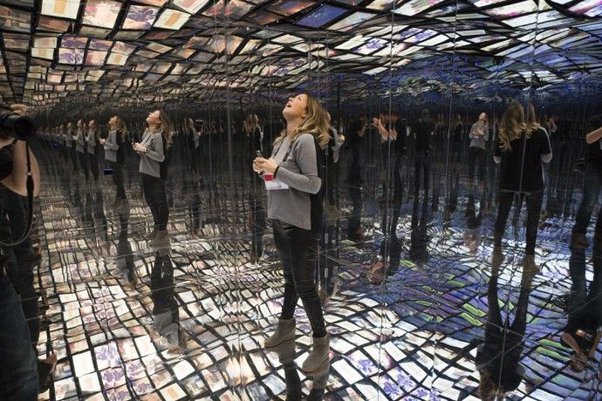
Also, once you start to look, the room will no longer be completely surrounded by perfect mirrors. It will need a little hole leading to your eye, which absorbs light that hits it as the first stage of sending a signal to your brain.
For the sake of argument, let’s say that you had a small hole (2mm diameter) in one of the walls and otherwise perfect mirrors around a very large room (10mx10mx10m).
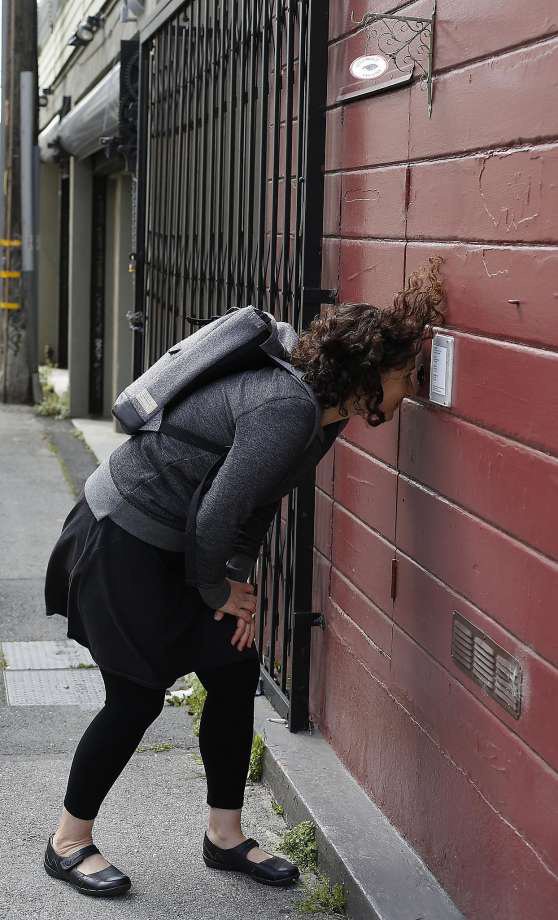
You look in through the hole. Then it could take something like a second for the light in the room to drain away to your eye, enough time to get a clear visual image. After a few seconds, when almost all the original light had been absorbed by your eye, what would be left is a glow of infrared light, the thermal equilibrium spectrum at the temperature of your eye, about 310K. Of course, your eye isn’t sensitive to that, since if it were it would always just be seeing its own glow.
Because mirrors aren’t perfect, and light moves fast.
A typical mirror only reflects 80–90% of the light that hits it. That means that, every time the light hits and bounces, it loses as much as a fifth of it’s intensity. Now, exceptionally reflective (and expensive) surfaces can achieve up to 99.999% reflectivity, and that sounds great, because you’re losing only 1/100,000 part of the intensity with every reflection. That means it would have to reflect 70,000 times to become half as bright as it was originally. Problem is, if the room is big enough that it has to travel an average of 10 meters between reflections, it will have that many reflections in less than a quarter of a second. In a room that reflective, the light would remain bright enough to be perceptible for a second or two, but would quickly drop to nothing.
There’s another problem, though. The light being perceptible means that something is perceiving it, which means something has to absorb the light. If you’re in the room, every time some of the light hits your body, it’s almost all going to be absorbed. Even if you could somehow wrap yourself in equally reflective material, you can’t see the light unless at least your eyes are exposed, which means that the light that’s hitting your eyes is still being absorbed. And given the speed of light, it’s all going to hit your eyes in pretty short order. You might possibly have a room that took a fraction of a second to fade to true dark, but no more than that.
Having a room made of mirrors would make the light appear brighter, but that light still needs a source, or it’s all going to be absorbed quickly.