If an astronaut outside the ISS has his or her tether broken, they do not fall to the Earth.
Before the tether was broken, the astronaut was in orbit at 17,500 mph just as the ISS was in orbit at 17,500 mph.
After the tether was broken, the astronaut will continue traveling with the ISS, possibly slowly moving away from the ISS depending on what the astronaut was doing when the tether was broken.
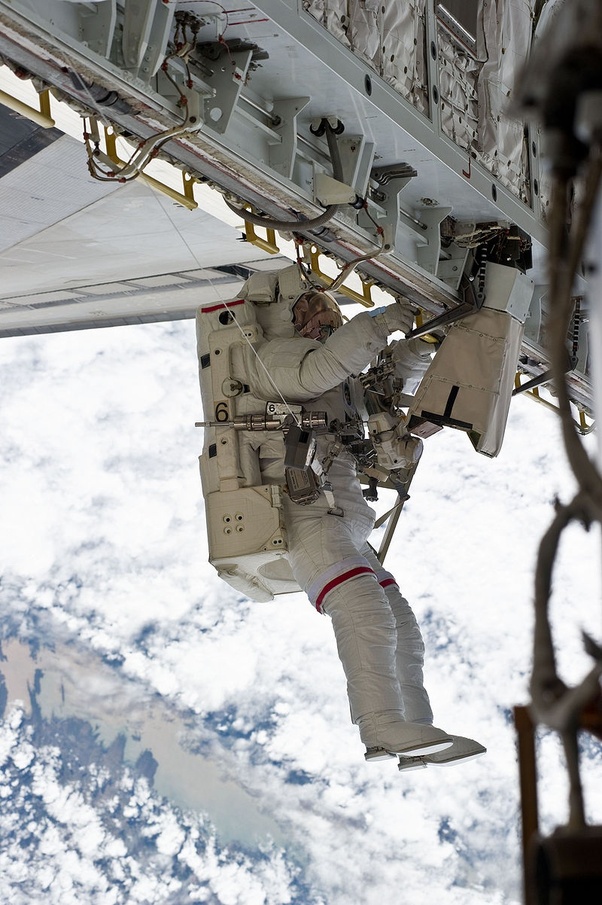
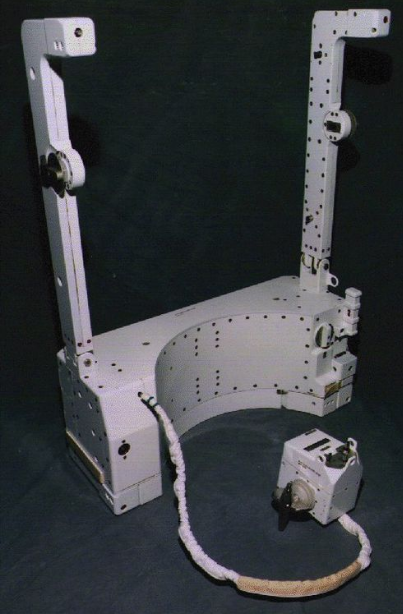
Every astronaut on an EVA is wearing a SAFER device, which uses gaseous nitrogen jets, controlled by the astronaut, to provide thrust for the astronaut to return to the ISS. The one in this photo has the number “6.”
We don’t have to guess about this. A fair number of objects have been released accidentally from the ISS covering a range from hammers to pieces of paper. These were tracked by NASA. They orbit the Earth from 100 to 1000 times, spiraling in due to atmospheric drag. Counterintuitively, they speed up slightly and orbit faster than the space station, converting potential energy into kinetic energy.
This takes from 7 to 80 days.
After this they burn up in the atmosphere about 100 km up from the ground.
Something with a ballistic coefficient like a human would take about 80 days.
Of course, the best thing to do is use your crew maneuvering unit to get back to an airlock pretty darn quick, because the longer you delay, the more you will drift away from the station due to atmospheric drag.
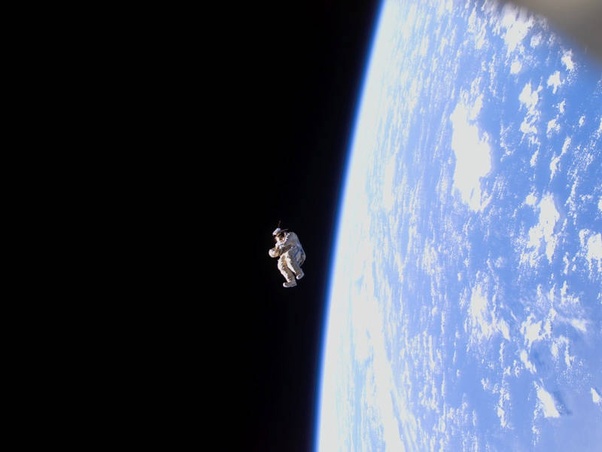
A space suit floats freely away from the International Space Station in a scene reminiscent of a sci-fi movie. But this time, no investigation is needed. The suit is was launched on Feb. 3, 2006. Dubbed SuitSat-1, the unneeded Russian Orlan spacesuit filled mostly with old clothes was fitted with a radio transmitter and released to orbit the Earth. It took several weeks to re-enter the atmosphere.