
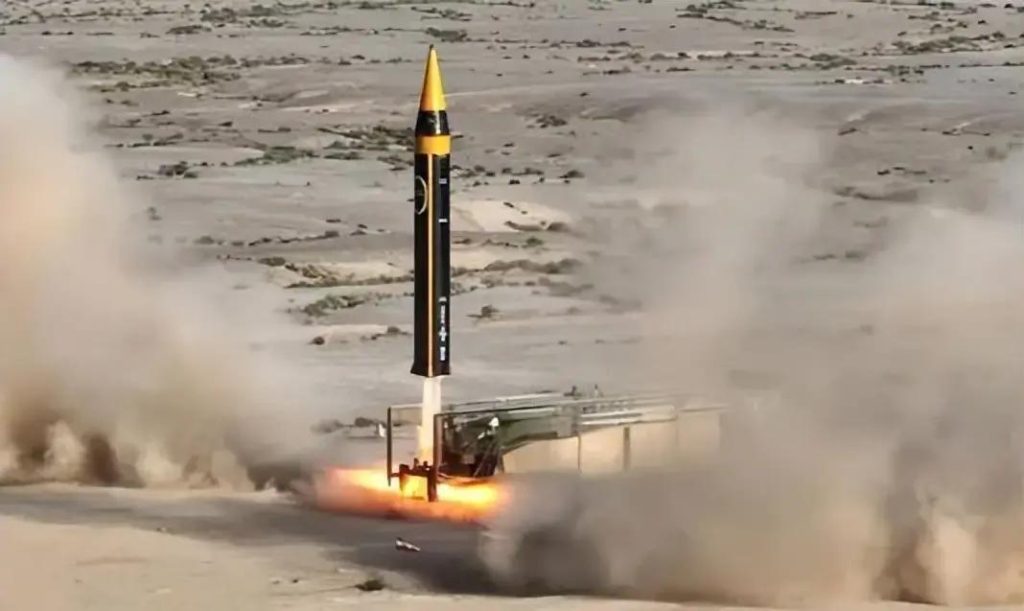
Iran’s hypersonic missile system, deployed in recent years, has recently been put into combat use. This missile boasts a peak speed of Mach 16 and can maintain Mach 8 maneuvers after re-entry into the atmosphere, with its terminal trajectory alteration capabilities significantly enhancing its penetration effectiveness.
Among existing air defense systems, only the Arrow-3 and THAAD systems possess a theoretical possibility of interception, but the probability of success is extremely limited.
The missile’s cost is controlled in the millions of dollars, while intercepting a single missile requires tens of millions of dollars in air defense resources. This cost difference makes intercepting low-value targets economically unfeasible, objectively enhancing the missile’s combat deterrent capability.
It is noteworthy that Iran carefully selected its targets, concentrating its attacks on high-value strategic nodes such as government buildings in Tel Aviv, the Prime Minister’s office, the air force command center, the Haifa military security center, and key facilities in East Jerusalem. Although Iran claims to have hit the Prime Minister’s office, Israel has not yet officially confirmed this.
From an operational deployment perspective, the stockpile of this advanced missile is limited. Iran employs a gradual strike strategy: first using conventional missiles to deplete air defense resources, then deploying high-tech missiles for precision penetration.
Theoretically, a reverse tactic—prioritizing the destruction of the air defense system before launching a saturation attack—could have yielded better results. However, limited by insufficient reconnaissance capabilities, the Iranian military struggles to accurately locate mobile air defense units, making the current tactics a practical choice. Battle reports indicate that some THAAD launch units have been damaged.
This military operation demonstrated Iran’s strategic counterattack capability. The initial decapitation strike failed to achieve its goal of a swift victory, instead triggering a stronger missile counterattack. Although the US attempted to downplay the impact of the strike, its statement adjusting the operational cycle to 4-5 weeks reflects a shift in its perception of the situation.
There are conflicting reports regarding the assessment of the strike’s effectiveness. Both sides implement information control during wartime, and the authenticity of the leaked, undamaged videos circulating online about the area around the Prime Minister’s office is difficult to verify.
However, it is certain that with the deployment of these killer weapons, the intensity of subsequent attacks will continue to escalate. Israel’s lack of strategic depth will place ongoing pressure on the protection of key targets.