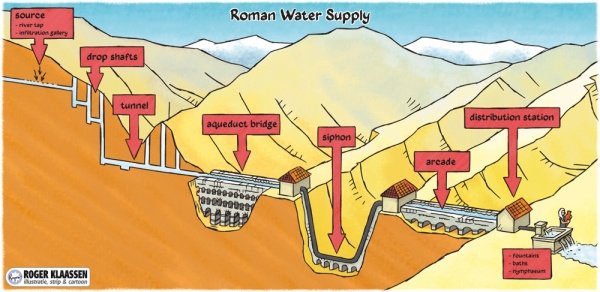
None of the other answers I’ve read actually explains how Roman aqueducts delivered relatively clear water. Yes, it was not necessarily germ free, but the addition of wine, vinegar, or myrrh pretty well took care of that problem.
The remaining problem was one of turbidity: stuff in the water. That “stuff” could, and did, include leaves, insects, silt, fecal matter, the bodies of small animals, and more.
This crud was mostly removed from the water by a construction known as a piscina limaria (literally “slimy basin”), in which the crud would mostly settle to the bottom as the water carried it through.
These settling basins were built in many different ways, depending on the shapes of the spaces in which they were put, but they were always located as near to the end of an aqueduct as could reasonably be worked out. Here is a schematic drawing that illustrates the principle on which they worked.
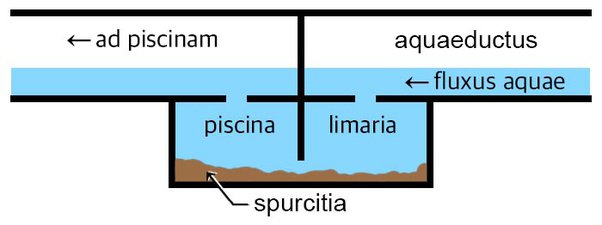
Terms:
ad piscinam = to the reservoir
aquaeductus = aqueduct
fluxus aquae = flow of water
piscina limaria = settling basin
spurcitia = filth
The “reservoir” would generally be a piscina (storage basin, or pool) or a castellum divisorium (distribution basin).
There was a drain opening in the piscina limaria, and part of the job of the aquarius (aqueduct manager) was to see that the crud was flushed out frequently enough that the flow was not impeded.
It is not correct as a couple other posters claim, that Roman water was always flowing and so limited bugs, dirt and the like. The water flowed due to gravity from higher to lower elevations, but usually came to rest at one point or another in settling tanks.
The purpose of these tanks was to remove and divert dirt, sand, rocks, stones, and the like from the water. As for bugs, since they float, the settling tanks wouldn’t have done much good. For this, if the aqueduct manager was so inclined, workers or slaves could remove floating debris by hand.
Obviously, the settling tanks generally remained at higher elevation than the destination in order to keep the water flowing. And there might be multiple settling tanks along the way, depending upon the length and location of the aqueduct.
But the fact is, Roman water while relatively clean and plentiful by ancient standards, would still have had a lot of “contamination” by present calculation, including lead residue from the pipes that often delivered it. Compared to a few pieces of bug here and there, that was probably much worse, though not known at the time.