There are two ways of going somewhere in space: the fast way or the economical way.
If you have a small unmanned probe, there’s no rush. No astronauts will die from boredom, lack of air or starvation. So you take the economical but slow way, only using the engine when it is most economical (at the lowest point of your orbit) to do so to raise the peak of the orbit one bit at a time until it is high enough for lunar capture.
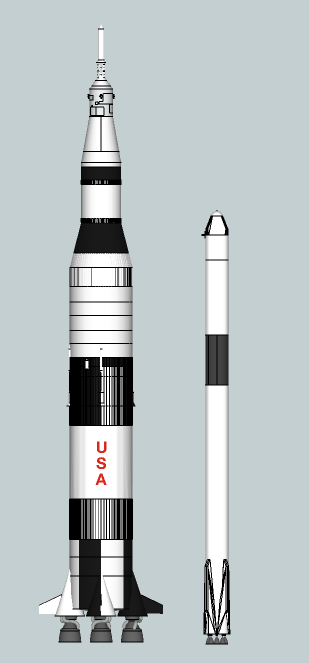
This of course takes time, but it requires a lot less fuel than going straight for the Moon, meaning that you can get to the Moon in a craft about two meters cubed. This means that you don’t need a huge super-expensive Saturn V to get to the Moon. A small cheap Falcon 9 will do.
If you are in a hurry, say, because there’s no way you can fit in the consumables needed for three men for a four-month journey (two months to the Moon, two months back home) in an Apollo capsule, and have to complete the mission in a week, or two at the most, then you need to go straight for the Moon.
It’s less economical and requires lots of acceleration and lots of thrust. That means that you need a humongous rocket for the fuel to get the acceleration and the thrust. So you use a Saturn V to get the crew there and back again in reasonable time.
As you can see, this means a lot for the kind of rocket you need, and conversely, the money you have to pay.
So in essence, it’s “never play an ace when a two will do”.