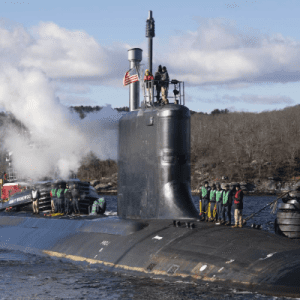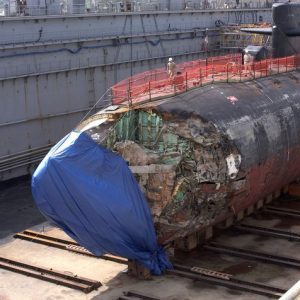
In short, pressure, exactly as happens at the bottom of the sea, is so large when you go kilometres deep that rock explodes without warning.
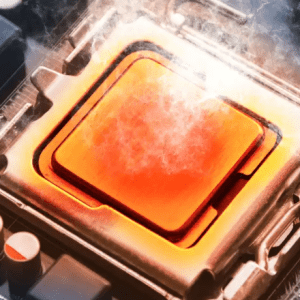
Temperatures raise without apparent end.
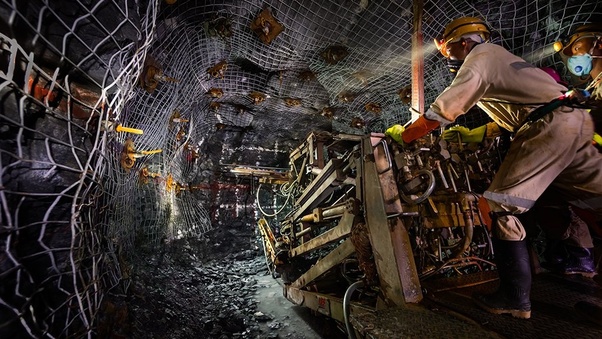
World deepest mine at Mponeng, in South Africa, reaches over 4 km deep, here you see how narrow is work front to minimize rock bursts
Rock stress reaches 96 MPa, equivalent to 10 km underwater; steel nets are to minimize people killed by rock fragments, brown blocks on the roof and sides are rock bolts
(thanks to Rudolph Buhrmann for correcting the data on rock stress, the machine in the picture was designed by him and his team and “operates entirely on high pressure cooled water, no oil hydraulics. The drills also run on high pressure water and the cold water cools the workplace.”
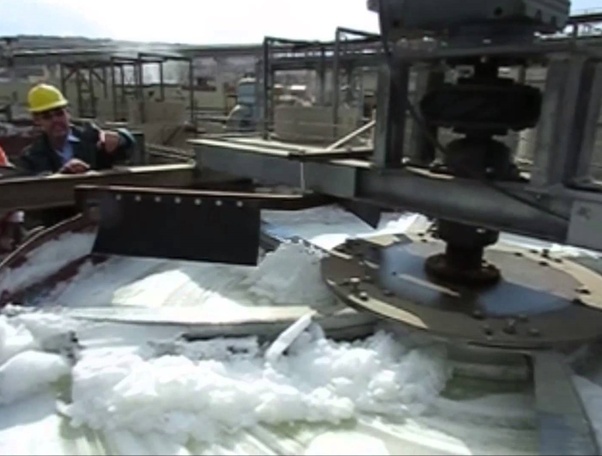
Mponeng ice generator injects ice into the mine to try to cope with temperature of rock
It injects 6000 tons of ice daily to cope with 66°C temperatures (151°F)
The deepest mine in the world, the Mponeng Gold Mines in the South African Republic reaches 4 kilometer (2.5 miles) below the surface. The depth of the mine results in high temperatures, reaching 60°C (140°F), and high humidity. To make it possible to work in the mine, extensive cooling systems, like pumping in ice slurry and circulating air, are in use.
It is possible to go even deeper, but with considerable risk for human beings working there unless in “space suits”. The deeper you go, the warmer it will become, typically 1 to 3°C per 100 meter.
At a depth of 3.5 to 4 km, the rock temperature can be high enough so that water under normal surface pressure will boil. The pressure at those depths, however, also increases, which raises the boiling point somewhat. At a depth of about 5 km the temperatures may exceed 170°C (340°F).
Robots will be able to work at an even larger depth.