It’s better to reverse the question and ask not how Voyager can send a signal strong enough, but how Earth can receive a signal so weak. The signal that leaves Voyager is only about 6 times as powerful as the signal from the average cell phone. It is much, much weaker when it gets to Earth.
NASA maintains what is called the Deep Space Network (DSN). It is composed of antenna sites in California, Spain, and Australia (each 120 degrees of longitude apart so that the the full Earth is covered).
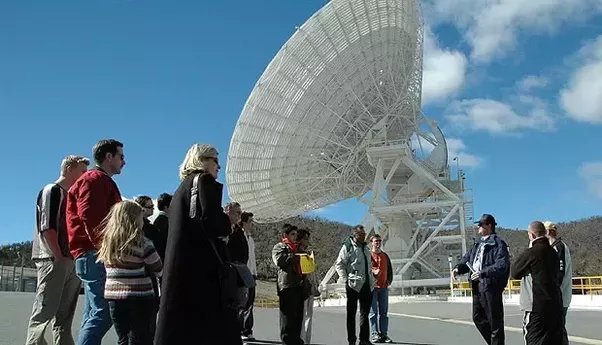
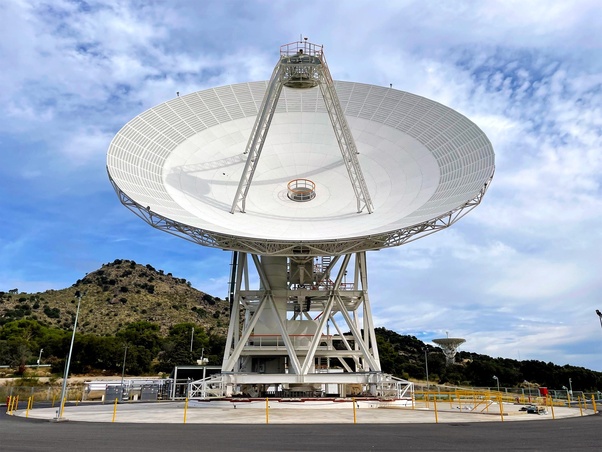
At these sites are giant dish antennae, ranging from 85 feet to 230 feet across. The antennae are parabolic (bowl shaped) – meaning they are designed so that every signal that hits them is reflected off of the curve towards the center where they are combined, making the signal stronger.
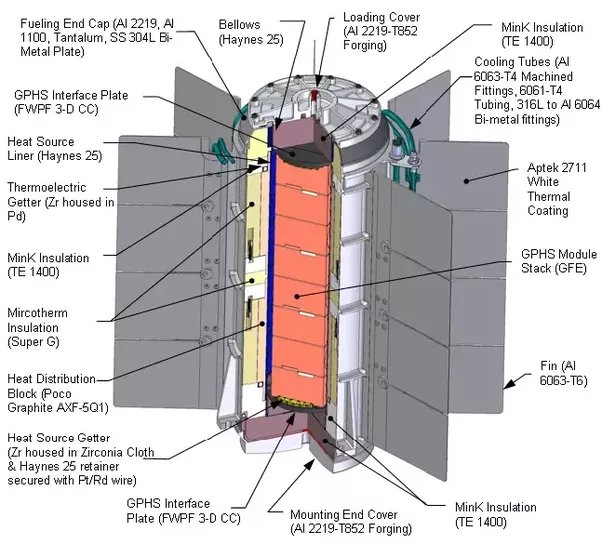
These giant antennae manage to pick up the weakest of signals. In fact, it is believed that the antennae could continue to receive Voyager signals even if it traveled for another century (although we expect Voyager’s power supplies to be too weak by about 2025). Voyager is powered by heat produced from radioactive decay. When it left Earth, that system had an output of about 450 watts. Today it is down to less than 250 watts.
When Voyager transmits a signal, from its high gain antenna that is pointed at Earth, the signal power is at about 19 watts, but it becomes weaker and weaker as it travels about 16 hours at the speed of light, to reach Earth.
By the time it hits one of the DSN antenna it is at about 10E-16 watts. Fortunately Voyager transmits at a very high frequency (x-band 8.4 GHz) which is not commonly used for terrestrial purposes, so the signal doesn’t get lost in the clutter from things like cell phones, TV, and GPS.
The DSN is unfortunately underfunded and much of the equipment is very old, so outages sometimes occur and we miss data. Also rain bouncing on the dish is enough to cause us to lose the signal.
As far as the strength of signal it is pretty faint. However, NASA has a bunch of 70 meter dishes located in Australia, the US, and Spain at 120 degree intervals. Those dishes are extremely sensitive and can pick up very weak signals. They look about like this. The tiny little thing in the lower right is 2 cars.
As far as power they use an RTG or Radioisotope Thermal Generator. It contains plutonium that has a 87 year half life. It slowly decays and generates heat. They use thermocouples to convert the heat difference to electricity.