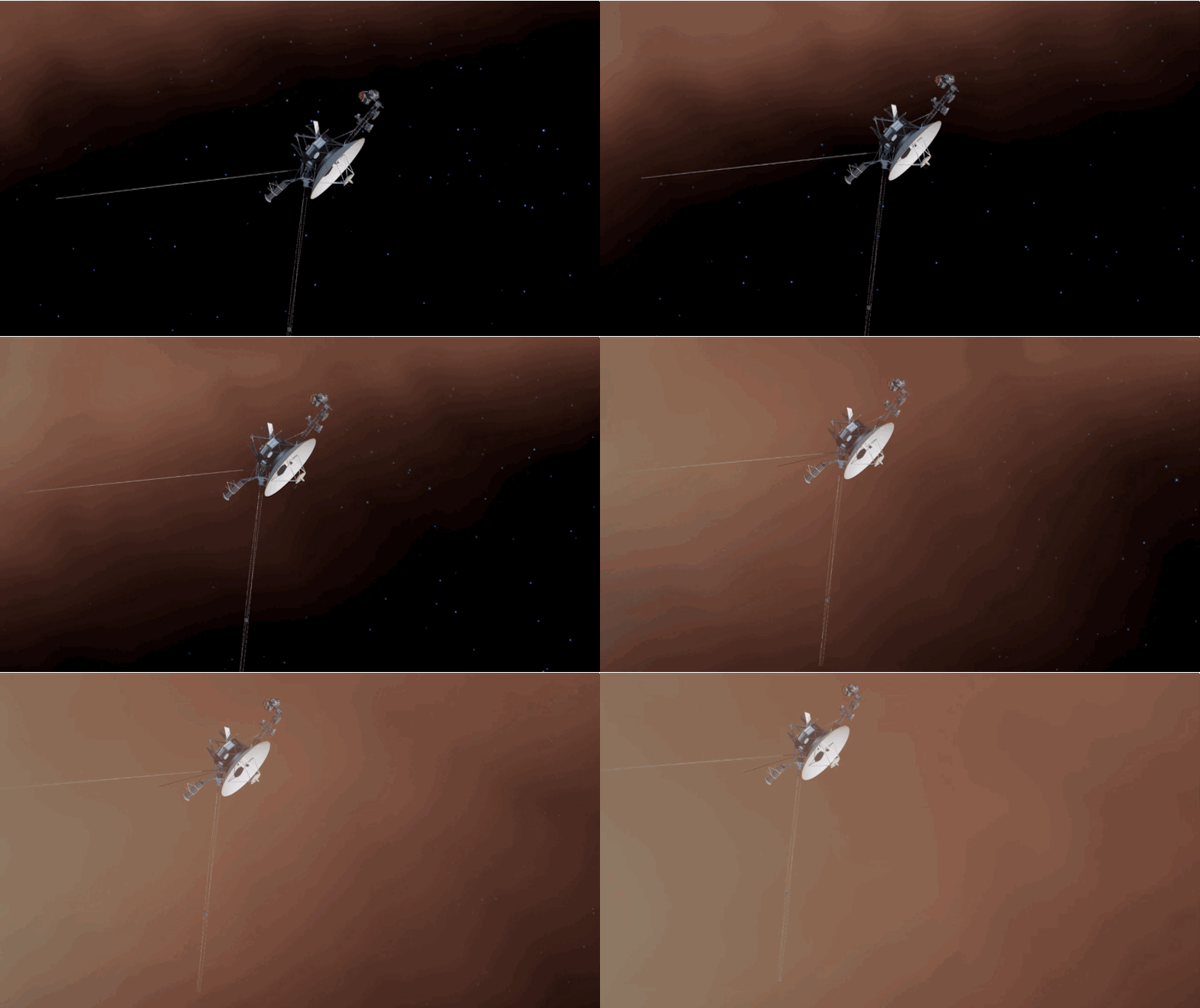
Voyager 2 is one of the most amazing space probes ever launched by NASA.
It was sent into space way back in 1977, and it’s still going strong today.
It’s the only spacecraft that has visited all four giant planets of our solar system: Jupiter, Saturn, Uranus and Neptune.
It also flew by several moons, asteroids and comets along the way.
In 2018, Voyager 2 became the second human-made object to enter interstellar space, after its twin Voyager 1.
It crossed the boundary of the heliosphere, which is the bubble of charged particles and magnetic fields that surrounds our sun and protects us from cosmic rays.
Now, Voyager 2 is exploring the interstellar medium, which is the stuff between the stars.
But, it hasn’t encountered any aliens or wormholes, if that’s what you’re hoping for.
But it has been sending back some valuable data about the conditions and characteristics of interstellar space.
For example, it has measured the density, temperature, pressure and magnetic field of the plasma in this region.
It has also detected cosmic rays from supernova explosions and other sources.
One of the most interesting findings is that the interstellar medium is not uniform or isotropic.
It varies depending on the direction and location of Voyager 2.
This suggests that there are structures and boundaries in interstellar space that are shaped by the interaction of different stars and their winds.
Voyager 2 is helping us map out these features and understand how they affect our solar system and other planetary systems.
Voyager 2 is still communicating with Earth, but it’s getting harder and harder as it moves farther away.
It takes about 17 hours for a signal to travel between Voyager 2 and Earth, and the power of its radio transmitter is weakening.
NASA estimates that Voyager 2 will run out of power sometime in the late 2020s or early 2030s.
on Nov. 5, 2018, NASA’s Voyager 2 became only the second spacecraft in history to leave the heliosphere – the protective bubble of particles and magnetic fields created by our Sun.
However, Voyager 2 is not yet in undisturbed interstellar space: Like its twin, Voyager 1, Voyager 2 appears to be in a perturbed transitional region just beyond the heliosphere.
The two Voyager spacecraft have now confirmed that the plasma in local interstellar space is significantly denser than the plasma inside the heliosphere, as scientists expected. Voyager 2 has now also measured the temperature of the plasma in nearby interstellar space and confirmed it is colder than the plasma inside the heliosphere.
An observation by Voyager 2’s magnetic field instrument confirms a surprising result from Voyager 1: The magnetic field in the region just beyond the heliopause is parallel to the magnetic field inside the heliosphere.
With Voyager 1, scientists had only one sample of these magnetic fields and couldn’t say for sure whether the apparent alignment was characteristic of the entire exterior region or just a coincidence. Voyager 2’s magnetometer observations confirm the Voyager 1 finding and indicate that the two fields align.