In November 1941, outside Moscow, at -30 degrees Celsius, a German soldier lay prone behind a snowdrift, his eyes fixed on the body of a Soviet soldier who had just been killed. His boots were cracked, and his toes were frozen purple.
As soon as the gunfire stopped, he rushed over, knelt down, and began to untie the Soviet soldier’s boot laces. His fingers stuck to the leather, and with a forceful pull, a piece of skin was torn off his fingertips.
Ignoring the pain, he put the boots on his feet—yesterday, a comrade in his class had his toes frostbitten and necrotic because he couldn’t get boots, and they had to be amputated.
How could the supposedly well-equipped German army have fallen so low as to steal enemy boots to save their lives?
01
At 3:15 a.m. on June 22, 1941, Germany broke the Molotov-Ribbentrop Pact and launched Operation Barbarossa.
Approximately 3 million German and Axis troops invaded the Soviet Union in three columns. Army Group North advanced directly towards Leningrad, Army Group South aimed at Ukraine, and Army Group Center—the largest and most powerful force—aimed at Moscow.
In the first three months of the war, the German army made rapid and unstoppable advances.
Minsk fell. Kiev fell. The German armored forces, like a sharp dagger, sliced through the Soviet defenses. It is estimated that over 600,000 Soviet soldiers were captured in the Battle of Kiev alone, a battle the Germans called “the largest encirclement and annihilation operation in human history.”
Hitler and his generals believed that the war would end before winter arrived.
This blind optimism had its reasons. France conquered in 39 days, Poland in 27 days, and the Netherlands in 5 days—for the past two years, the German blitzkrieg had been virtually invincible. The Soviet Union was merely the next adversary to fall.
The German High Command even estimated that it would take 120 divisions to conquer the Soviet Union within 5 months.
No one felt the need to seriously prepare winter clothing. According to the plan, by the time winter arrived, German soldiers should already be celebrating their victory in the Kremlin Square.
02
To be fair, the German high command was not entirely unprepared for winter clothing.
Records show that the German public even responded to the call and donated approximately 200,000 sets of cotton clothing. Indeed, the warehouses behind the factory were piled high with blankets, gloves, and winter coats.
The problem lies elsewhere: these supplies simply cannot be delivered to the front lines.
The first hurdle was the railway. Soviet railways were broad gauge, which German trains couldn’t pass through. The German army could only unload supplies at the border and transfer them to Soviet trains, or simply transport them by truck.
The second hurdle was the roads. In the eyes of Western Europeans, the roads in the Soviet Union could hardly be called roads—they were muddy and impassable in spring and autumn, and the wheels would get stuck; in winter, heavy snow blocked the roads, and the snow could be more than half the size of a car wheel.
The third hurdle was distance. As the German army advanced eastward, the supply lines stretched longer and longer. The straight-line distance from the border to the outskirts of Moscow exceeded 800 kilometers.
Army Group Center required at least 75 trainloads of supplies daily to sustain operations. In reality, only 25 to 40 trainloads typically arrived. Ammunition, fuel, and weapons—these were higher priorities; winter clothing had to be relegated to the back burner.
By October, half of the German army’s logistics trucks were broken down. Gasoline consumption was alarming, and engines were frequently malfunctioning in the mud and freezing temperatures. Some divisions went ten days without a single bite of bread and had to scavenge for food on the spot.
Winter clothes? The warehouses at the train stations in Warsaw and Smolensk are overflowing with them.
The soldiers on the front lines couldn’t even find a complete pair of cotton socks.
03
In mid-October 1941, the Soviet winter arrived earlier than usual.
Temperatures plummeted from 10 degrees Celsius to -20 degrees Celsius. Within a week, they dropped to -30 degrees Celsius. By early December, the lowest temperatures in the Moscow region had fallen to -40 degrees Celsius.
This was one of the coldest winters in Europe in the 20th century.
What did German soldiers wear? Standard Western European single-layer leather boots—0.8 cm thick leather, unlined, designed to cope with the mild climate of Germany and France. These boots would harden and crack at -10 degrees Celsius, and at -30 degrees Celsius, they were practically like popsicles.
The soldiers began stuffing newspapers into their boots and straw into their underwear. But the newspapers quickly froze into hard lumps, causing their feet to rub raw and bleed.
The number of people suffering from frostbite has begun to surge.
According to records, Army Group Center suffered over a thousand frostbite injuries in the first week of November. Among them, about 300 had their toes frostbitten and required amputation to save their lives.
A snow removal team of 93 people lost 65 people to freezing to death in one night.
The soldiers’ socks were soaked with sweat during the day and froze into ice blocks at night. Their soles and toes were frozen inside the socks, and some soldiers even tore off their skin and flesh when they took them off.
Tank engines wouldn’t start, machine guns jammed due to solidified lubricating oil, and artillery sights malfunctioned—the severe cold had reduced the German army’s equipment to the Stone Age.
04
Just when the German army was being thrashed by the cold, the boots on the Soviet soldiers’ feet became their lifeline.
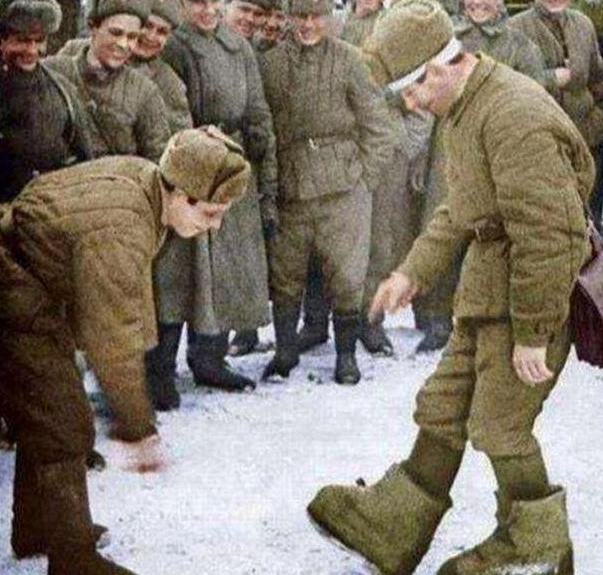
The Soviets were all too familiar with the bitter cold. The winter boots they issued to their soldiers were called felt boots, or valenki in Russian—these boots were made of compressed wool felt and had wide shafts that could be stuffed with foot wraps or hay.
Felt boots can keep feet warm for hours in temperatures as low as -30 degrees Celsius or even lower. Russian hunters and farmers have worn them for centuries, and the Soviet Army adopted them as standard winter gear.
In contrast, the German army’s single leather boots were a death sentence.
In late October 1941, the German 3rd Panzer Division captured Soviet felt boots on a large scale for the first time after a small-scale battle. German soldiers, accustomed to wearing single-layer leather boots, found that their feet were finally no longer cold after putting them on.
The news spread quickly at the front lines.
More and more soldiers began rushing to the Soviet corpses immediately after the battle ended. Their only goal was to find a pair of comfortable felt boots.
For them, these boots were not spoils of war.
It is the hope of survival.
05
As winter intensified, the looting of Soviet soldiers’ felt boots went from being isolated incidents to becoming an unspoken rule among German troops.
After each battle, the soldiers, without bothering to clear their weapons or gather the wounded, rushed into the piles of Soviet corpses. Some fought with their comrades for a pair of boots that fit. Some preferred to carry extra boots on their backs rather than give them up.
Battlefield records mention that 80% of the soldiers in a squad were wearing Soviet felt boots, while the remaining 20% who didn’t get any had suffered varying degrees of frostbite.
The German high command initially wanted to prohibit this behavior, which they considered “damaging to military prestige.”
But seeing the frostbite rate soaring, they could only turn a blind eye. In early December, the German 9th Army even subtly mentioned in an internal report: “We can collect enemy winter clothing to supplement our own needs in order to cope with the severe cold.”
This statement became a tacit signal of approval for the boot-grabbing.
In December 1941, the temperature in Moscow dropped to -38 degrees Celsius. This was the peak of the German army’s boot-grabbing frenzy.
A German soldier wrote in his diary: “Today I killed a Soviet soldier; his boots looked brand new. I had just crouched down when I heard a bullet whizz past my ear, so I quickly lay down. As soon as the gunfire stopped, I immediately took off my boots and put them back on. My feet were so cold I couldn’t feel them; if I wore my old boots again, I definitely wouldn’t make it through the night.”
Some people also recorded that when they managed to grab the boots, they found that the boot shafts were still covered with the frozen feet of Soviet soldiers. They had no choice but to grit their teeth and pull their feet out, stuffing dry grass into the boots to keep them warm.
Some soldiers got into fights with their comrades over a pair of size 39 felt boots that fit properly. One was slashed with a knife, and the other had his ribs broken. While the medic was bandaging them, the two were still arguing about who should get the boots.
Those felt boots became his only hope for survival. But the question is, how did the supposedly well-equipped German Wehrmacht end up in such a state?
06
Soviet railways were broad gauge, 85 millimeters wider than the European standard. German trains simply couldn’t get through; they had to unload and transfer cargo at the border. German railway engineers desperately tried to convert the broad gauge to narrow gauge, but the conversion speed couldn’t keep up with the advance at the front.
When the German army advanced to Smolensk in August 1941, the nearest railway supply depot was still hundreds of kilometers away from the front line.
Trains are unusable, so we have to rely on trucks.
But the Soviet roads made life miserable for the German trucks. The autumn “swamp season” turned the roads into mud pits, and the trucks got stuck and couldn’t move. Heavy snow in winter blocked the roads, fuel consumption soared, and engines frequently broke down in the cold.
According to statistics, the amount of fuel consumed to travel 100 kilometers in Western Europe could only travel 70 kilometers in the Soviet Union.
By the end of 1941, only 25% of the trucks in the German army’s logistics department were still usable.
Winter clothing was prepared, but it was piled up at a train station hundreds of kilometers away in the rear. The frontline workers could only watch helplessly. Large quantities of cotton clothing donated by the German people did not arrive at the front until the end of January 1942. By then, the severe cold had already caused very serious casualties.
Commanders at all levels tried every possible means to save themselves.
Some divisions organized large-scale garment workshops in Soviet towns, having local workers hastily assemble winter gear from felt and old clothes. Others requisitioned fur coats and felt boots from local people. Still others—stripped winter clothing from the bodies of dead Soviet soldiers.
This is not an isolated phenomenon. It is a tacitly accepted unspoken rule.
The SS and Luftwaffe fared slightly better, as their logistics systems operated independently and they donned winter clothing early on. The German Army, however, was in dire straits, forced to fight in the freezing cold wearing only autumn uniforms.
07
During the entire Battle of Moscow, the German army reported more than 130,000 cases of frostbite.
In December alone, 100,000 German soldiers were rendered combat ineffective due to frostbite. Guderian’s 2nd Panzer Group had only 190 tanks available, not from fire, but from frostbite.
The severe cold reduced the German army’s fighting capacity by half.
The soldiers’ plight was appalling. Their socks were soaked with sweat during the day and frozen solid at night. Their soles and toes were frozen together, tearing off the skin and flesh when they took off their boots. Soldiers without gloves had their hands frozen so much that they were stuck to their rifles, inseparable.
Some people’s toes frostbitten and become necrotic, requiring amputation. Some people couldn’t even save their entire foot. And some people never woke up after being frozen stiff.
Under these circumstances, the soldiers who managed to obtain Soviet felt boots had a significantly lower rate of frostbite than their comrades who wore single-layer leather boots.
A pair of boots determined who would leave Moscow alive.
This comparison is too harsh.
The supposedly well-equipped German Wehrmacht was reduced to fighting the enemy for shoes outside Moscow. This wasn’t because Germany couldn’t produce winter boots, but because its logistical system was completely paralyzed, and nothing could be delivered.
Hitler and his generals underestimated the Soviet Union. They underestimated the vastness of the land, the harshness of the climate, and the difficulty of extending the logistical lines for millions of people thousands of kilometers away.
The Blitzkrieg victory blinded them. They thought they could end the war before winter arrived, so they didn’t prepare properly. By the time winter truly came, it was too late.
08
On December 5, 1941, the Soviet army launched a counter-offensive.
By this time, the German offensive had long since stalled. The vanguard had advanced to the outskirts of Moscow, at one point only 23 kilometers from the Kremlin. It is said that German officers could already see the Kremlin’s spires through their binoculars.
But this is already their limit.
Army Group Center was unable to advance. They were running out of ammunition, fuel, food, and especially winter clothing. The soldiers were so cold they could barely hold their rifles, and the tanks were stuck in the snow and wouldn’t start.
The Soviet counterattack was swift and fierce.
Reserve troops transferred from Siberia and the Far East were deployed to the battle. These troops were well-equipped and supplied for winter. They wore thick cotton-padded coats and felt boots, and their guns were coated with antifreeze lubricant, allowing them to move freely in the icy and snowy conditions.
In contrast, the German troops were poorly dressed, hungry, and cold.
The Soviet army drove the German forces back 100 to 250 kilometers from the outskirts of Moscow. This was the first strategic retreat for the German army since the start of the war.
During the retreat, the snowfield was littered with German soldiers’ single-layer leather boots. Some boots had cracked shafts, some had broken soles, and some still had frozen, blackened toes inside.
Those soldiers who were lucky enough to snatch Soviet felt boots became the few who managed to leave Moscow alive.
09
The Battle of Moscow ended on January 7, 1942.
The German army suffered its first strategic defeat since the start of the war, and was forced to retreat from the area around Moscow. According to the Soviet Military Encyclopedia, the German army lost more than 500,000 men, 1,300 tanks, and 2,500 artillery pieces in this battle.
There are many reasons for this defeat.
The Soviet army’s fierce resistance, the harsh weather, and the overextended battle lines caused by the division of forces—each factor played a role. But the complete collapse of the logistical system was undoubtedly the most fatal blow.
The German army wasn’t lacking winter clothing; rather, it couldn’t get it to the front lines.
The soldiers didn’t lack the desire to keep warm; they simply had to resort to stealing boots from enemy corpses to save themselves.
Postwar statistics showed that German soldiers wearing Soviet felt boots had a much lower rate of frostbite than their comrades wearing single-layer leather boots. A pair of boots determined who could save their feet and who could save their lives.
This scene became the most ironic footnote to the German army’s logistical failures in World War II.
Millions of troops swept across Europe, only to be stopped by a pair of boots outside Moscow. The railways couldn’t bring them in, the roads couldn’t pass, and the winter clothing piled in warehouses became useless.
Hitler later dismissed Army Commander-in-Chief Brauchitsch and replaced a number of generals, including Army Group Center Commander Bock and Guderian.
But changing personnel won’t solve the problem. The problem lies in strategic judgment: a plan that underestimates the opponent, the distance, and logistics is doomed to failure from the start.
The Barbarossa Project was named after Frederick I, the Holy Roman Emperor known as “Redbeard,” who led an army eastward but ultimately drowned in a river in Asia Minor.
More than 700 years later, the battle named after him also ended in defeat.