I’m an 8 year submarine officer, Nuclear engineer qualified, Officer of the Deck Qualified.
To answer your question, NO. Submarines seldom settle on the floor except in a very narrow subset of operations.
Why in the world would you want to settle on the bottom and sit in the goo that exists in a silt layer on the bottom which can be many meters deep- clogging your seawater intakes and fouling your heat exchangers?
Moreover, what benefit would there be in placing the conformal sonar arrays and bow mounted sonar arrays into this bottom goo further degrading their abilities?
Submarines are neutrally buoyant and can station keep for prolonged periods so why sit on the bottom which can have many adverse effects to the vessel including dinging the screw and creating a huge noise vulnerability? Submarines don’t usually sit at the bottom of the ocean.
I have experience on both nuclear submarines and diesel submarines, I cannot recall anytime that we willingly put our submarine on the ocean floor. The possible negative outcomes far out weight any benefit that you can gain.
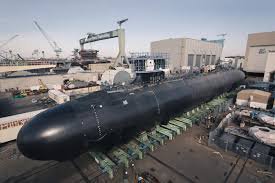
here you can see all the supports the are needed to keep a submarine’s hull straight and even when not floating. If any of these supports are incorrectly aligned the hull can be permanently warped or twisted. This can cause mechanical failure in machinery like Diesel engines or pumps or turbines. If the warp or twist is severe enough it could lead to structural failure. Twist or warp the hull enough and then you problems like hatch clearances being off. Crankweb deflections can be so bad that the diesels won’t rotate. Diesel submarines have to worry about this as well.
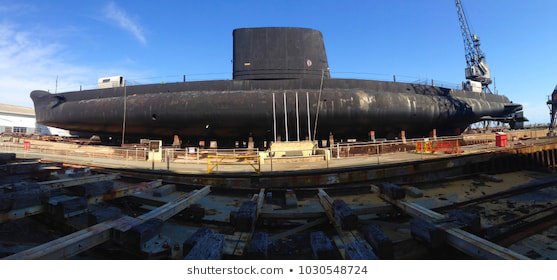
Nothing good can come out of deliberately bottoming a submarine. Even if you don’t twist or warp the hull. You still have damage to the sound dampening coating to worry, damage to your sonar systems, damage to exposed propellers. Plus the usual clogging of many seawater systems that are used to cool the submarine and equipment.
Barring any of that damage you still have a huge cloud of mud, muck and sand that you just created in the water. Any airborne observer would spot that immediately. Thus serving notice that something very large is underneath it. So it is all around a very bad idea.