Whoa! You’re underestimating the north star! POLARIS – Dhruva for us in India – is a multiple star system containing a total of 5 stars.
Polaris appears to us as a single star, but it is actually a stellar system containing 5 stars. The primary star dubbed Polaris A is the star we see – and it is a yellow supergiant. It is a little over 5 solar masses and is about 46 times the diameter of the Sun.
It has expanded – after leaving the main sequence. It is more than 1,200 times more luminous than the Sun, with the surface temperature of about 6,000K. It is a classical Cepheid variable star, meaning its brightness varies over time. This variability is due to pulsations in the star’s outer layers. Polaris is larger, more massive, more luminous, and hotter – than the Sun.
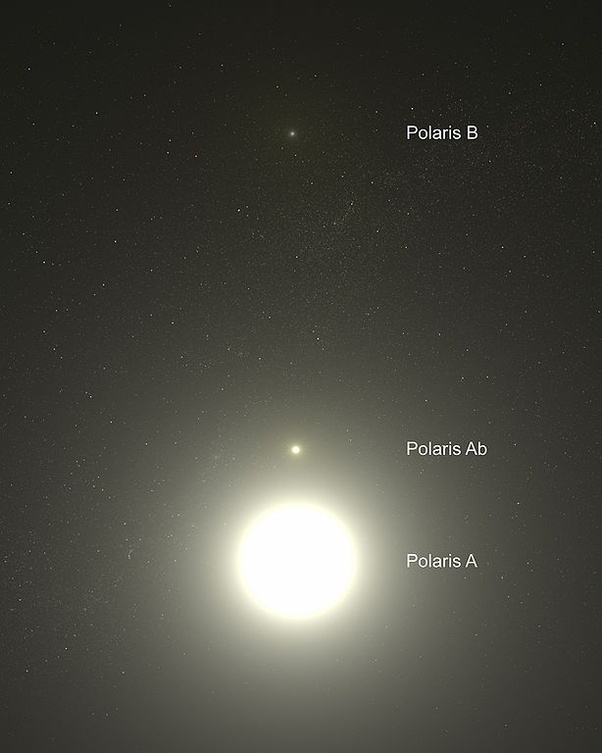
Polaris Ab is a small companion star that orbits Polaris A at a distance of 18 AU. They form a spectroscopic binary, meaning their separation is too small to be resolved with an optical telescope, but their binary nature can easily be inferred from their spectral lines. This star is estimated to be 1.26 solar masses.
Polaris B is a main sequence star with about 1.4 solar masses, and is about 2.5 times the diameter of the Sun. The surface temperature is 6.900K and the star is about 4 times more luminous than the Sun. It is located at an average distance of about 2,400 AU from the primary Polaris Aa.
Polaris C and D are faint companion stars, but specific details about their spectral type and characteristics are not well-documented. They are located at a significant distance from the primary star, Polaris A.
It is not known if there are planets orbiting any of these stars.
Polaris C and D are not related to the system. That leaves only the three stars in the Polaris cluster.