

According to the latest research, the nearest technological civilization in our Milky Way Galaxy might be about 33,000 light-years away, assuming such civilizations tend to exist for at least 280,000 years
This second requirement might be difficult to achieve if human civilization turns out to be shorter-lived. After all, we only invented writing about 5,400 years ago.
In this case, if technological civilizations last only a fraction of 280,000 years, then there might not be any in the whole Milky Way Galaxy together with us now.
It might turn out that we are too pessimistic, and technological civilizations could last millions or even billions of years. In this case, there might be many in our galaxy at the moment.
Nevertheless, 33,000 light-years away is very far. We are located 26,000 light-years away from the galactic center. At 33,000 light-years away, another civilization could be literally on the other side of the galaxy, and it would not be easy to know that they exist. Especially if they only ever occupy one star system.
The diameter of the Milky Way is just over 100,000 light-years, and extraterrestrials could be in any direction. Even with immensely powerful technologies for detecting our electromagnetic signals, they will remain unaware of our existence for 33,000 years until our radio waves reach them. Even then, there will be no way for meaningful communication as signals would need to travel 33,000 years one way and back to receive a reply.
This research was based on several assumptions, which had to be guessed, as we are the only known technological civilization on which some values could be established. Some of these values could dramatically change the conclusions. They might not be as bad, or they could be much worse, and there might not be another alien civilization in the Milky Way no matter what.
If you pose a question about “the universe,” we stumble over infinities. These lead to all sorts of loopy conundrums. (“Maybe there’s a civilization exactly like ours, except their Baskin Robbins has not 31 but 32 flavors of ice cream, so it’s even more advanced!”)
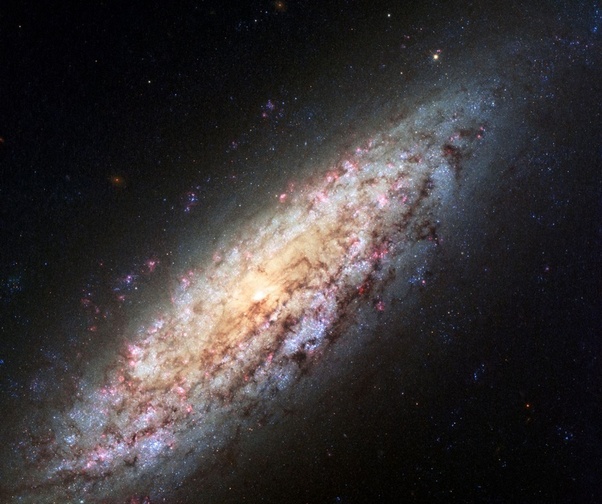
Let’s limit this discussion to our Milky Way galaxy. That’s plenty big, with at least 100 billion stars, most of which have planets, some of which give hints of having basic life.
Yet, even with all that opportunity, Earth might harbor the *only* technologically advanced civilization. Why’s that? Several reasons. First, evolution has no reason to produce advanced technology such as that we have built around ourselves. Actually, evolution has no “reason” at all, but it does have what the late, great philosopher Daniel Dennett called free-floating rationales, unexpressed, implicit reasons for its “choices.” They are whatever best serves survival and reproduction. Natural selection simply propagates that which successfully replicates.
Intelligence has evolved numerous times on this planet, but it is nearly always disciplined by the survival and reproduction requirements of the environment in which it lodges. Bees, for example, are fantastically intelligent, given their brain size. Worker bees do many different jobs requiring judgment (“Should I keep making honeycomb or join others at the entrance to fan and cool the hive?”), abstract thought (“How should I interpret the bee-dance I am witnessing?”), and planning (“On my next foraging trip, I’d better pass on nectar and bring back water instead.”)
Collectively, bees form a superorganism, with no one in charge (not even the queen) yet all working for a common cause — one determined by evolution. Could bees ever develop advanced technology? Not likely. There’s no reason for them to do so. Not even a free-floating rationale.
Human intelligence is freakish. It’s really not well explained. Evolutionary psychologist Geoffrey Miller argues that it’s an instance of runaway sexual selection, but there are problems with that hypothesis. In any case, our best explanation seems to include a series of accidents, including bipedalism, which came long before the rapid expansion of human brains, a gene shift that allowed vocal complexity (leading to human musicality and eventually to language), and mastery of fire, which led to cooking, which then led to a trade-off between the digestive tract and the ever-growing brain. All this took place over roughly 3 million years of evolution, with change accelerating as we went along.
Could it happen again? Maybe, if the winds of selection blow in that direction. There’s a well established phenomenon called convergent evolution where a useful feature gets reinvented over and over. The eye is one (it evolved at least seven times), wings are another. Is the ability to do chemistry, metallurgy, and electronics yet another?
It’s by no means clear that we’ve done ourselves a longterm solid by mastering technologies. Apart from the any-moment-now possibility of self-extinction through nuclear war, we‘re sawing through the natural limbs that support us — the marine ecosystems, the climate boundaries, and the chemical toxicologies — at a rapid pace.
It’s possible that our governance systems will suddenly recover from the lunacy that currently grips them, but there’s no sign whatever of that. So, going by the only indicator we have, there’s no reason to assume that the galaxy is teeming with advanced civilizations.
With that in mind, I recommend W.H. Auden’s great poem, “The More Loving One,” which begins:
Looking up at the stars, I know quite well
That, for all they care, I can go to hell,
But on earth indifference is the least
We have to dread from man or beast.
How should we like it were stars to burn
With a passion for us we could not return?
If equal affection cannot be,
Let the more loving one be me.