I knew the pilot who flew that C-130, Jim Flatley. He was CAG in my first airing onboard USS Independence. He was frequently asked about that effort.
The answer is that although it was proved possible, while the C-130 was on the flight deck, it was impossible to do any other flight ops. And if the C-130 went down while on deck, the carrier would be completely out of service. As bad as an enemy attack.
So that was not good. Nice experiment. Operationally unacceptable.
The C-130 landed and took off fine on a “clean” flight deck and it had about 15 feet of wing clearance with the island. In the end though, having an empty flight deck to land a big cargo plane wasn’t really practical.
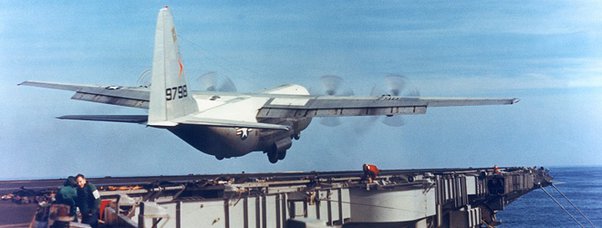
At the time, was an emergency need to resupply a carrier operating in the middle of the Indian Ocean, a common operation today but an unanticipated requirement four decades ago. The Grumman C-1 Trader, then the Navy’s carrier onboard delivery, or COD, transport, did not have the required range nor could it carry an oversize payload like a General Electric J79 jet engine, which powered both the North American A-5/RA-5 Vigilante attack/reconnaissance aircraft and the McDonnell Douglas F-4 fighter bomber populating flight decks at the time. The C-130 had both range and cargo-carrying ability so the idea of a Super COD was born.
The KC-130 weighed 85,000 pounds on the first landing. Thereafter, landings were made in progression up to a gross weight of 121,000 pounds. At maximum weight, which set the record for the largest and heaviest aircraft landing on a US Navy aircraft carrier, Flatley and Stovall used only 745 feet for takeoff and 460 feet for landing.
One landing at a weight of 109,000 pounds required 495 feet to stop and that was in a heavy squall. On the last takeoffs, the crew didn’t even back up — they simply took off from the point on the deck where the aircraft stopped.
The feasibility of landing a C-130 with a useful payload on a carrier was clearly demonstrated, but in the end, it simply was not practical. A carrier with no tactical aircraft on deck makes a skipper antsy. The captain of the Forrestal gave us two hours — to the minute — each trip and then they had to go home. The Grumman C-2 Greyhound, a more practical COD aircraft, entered fleet service in 1966.