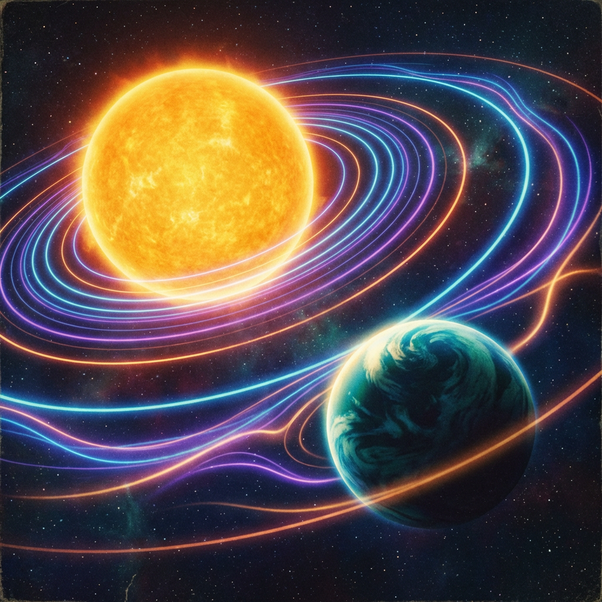
If gravity takes time to reach Earth, we should be pulled toward where the Sun was 8 minutes ago. This delayed pull should fling us out of the solar system. So why doesn’t it?
Richard Feynman never claimed this paradox meant gravity travels faster than light. In fact, he taught exactly the opposite. The puzzle was actually proposed by the French mathematician Pierre-Simon Laplace in the 18th century.
Because the Sun and Earth are constantly moving through space, a delayed pull would come from a slightly different angle. This misalignment would create a subtle sideways force, or torque. Laplace calculated that if gravity moved at the speed of light, this torque would constantly add angular momentum to the planets, causing them to spiral outward and escape the solar system entirely.
To keep orbits stable, he concluded gravity had to travel millions of times faster than light.
When Albert Einstein published his theory of General Relativity, physicists had to resolve this exact problem. Feynman later explained the solution beautifully in his lectures. The mistake in Laplace’s calculation was assuming that gravity acts exactly like a simple pulse of light.
In General Relativity, the gravitational field of a massive object does not just contain information about where the object was; it also encodes information about how the object is moving. Because the Sun moves at a relatively constant velocity, its gravitational field naturally extrapolates its position.
The “pull” felt by a planet points toward the Sun’s present, instantaneous position, perfectly canceling out the aberration that would cause a torque. The delay is still there, but the structure of the moving field effectively hides it for objects moving at constant speeds.
Modern astronomy has definitively settled the speed of gravity. In 2017, observatories detected the collision of two neutron stars 130 million light-years away. The event emitted both a burst of gamma rays and ripples in spacetime known as gravitational waves.
Both signals traveled across the universe and arrived at Earth within 1.7 seconds of each other. This historic observation proved definitively that gravity does not travel faster than light; it travels at exactly the speed of light.