Just because they are big. Let me explain.
Nowadays, the role of a strategic bomber is obsolete, as these big flying clunks are really easy prey for modern missiles and aircraft, the best part is that they cannot really defend themselves. So in this sense, they do not outlast newer planes. If you want to strike a precise and well-defended area, you’d be more advised to send things like B-2 bombers. A combat box of B-52 will outright be annihilated by any vague fighter opposition.
But here’s the thing. You don’t really need anymore to send 500 strategic bombers carpet-bombing a random factory and killing 100 000 civilians, WW2 style. Nowadays, hopefully, we invented those rather funny candies:
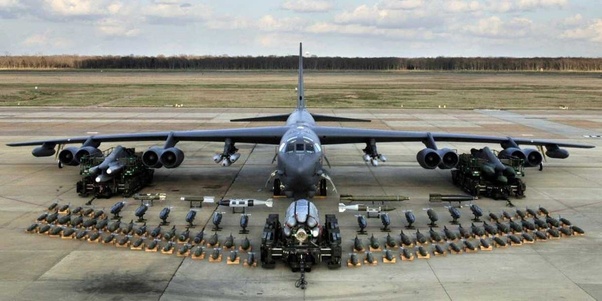
This is a GBU-15, a TV/IR guided bomb that can be launched from 15 nmi (roughly 28 km with mental calculation). The fact that it can be launched from 15 nmi away means that you don’t really have to expose yourself to some threats, meaning that your survival chances are noticeably better, compared to carpet bombing.
So the fact that “heavy bombers” like the Tu-95 or the B-52 are vulnerable isn’t that much of a concern anymore (well, it still is but not as much as it used to be).
So logically, the characteristics that matters the most for this job is the load carrying capacity.
Where a F-16C block 52 has a carrying capacity of roughly 17 000 lbs / 7700 kg (and he will carry at least 12 000 lbs / 5500 kg of missiles/external fuel tanks meaning that only ~5000 lbs / 2250 kg of Air-to-Ground ordnance is usually carried), and where a Su-27SK can carry (according to my calculations and realistic estimations) 20 000 lbs / 9100 kg of ordnance (MTOW), which only ~8000 lbs / 3600 kg are supposedly A-2-G ordnance…
A B-52H can carry a whopping 70 000 lbs / 31 150 kg of fuck-you-and-die, which roughly translates to 32 (!) GBU-15s, and a Tu-95MS can carry 44 000 lbs / 20 000 kg of A-2-G kindness. Which translates to roughly 20 GBU-15s (if he could carry them).
To put it into a nutshell, they are just used as missile trucks.