As usual, Mythbusters to the rescue.
They didn’t really test this but rather an adjacent conundrum of whether a bullet fired high up in the air might be lethal when it comes down. To that end, they shot a pistol and an M1 Garand vertically.
What they found was that yes, it might be lethal. However, it’s extremely unlikely for it to come straight back down to the shooter—but that doesn’t mean it can’t hurt someone somewhere else. A few people had been killed by celebratory gunfire. They also found that out of the so many rounds fired off the Garand, they only managed to find only one of them in that big open dry plain, with the rest having been blown away somewhere else.
What does this mean for flak? Flaks are pretty much the same. They’re meant to explode up high by the use of timed fuses. Before they are fired, the gunners set how long or how high before the shell should explode. When the shell explodes, it throws thousands of small shrapnel everywhere that can damage airplanes and kill or wound the crew.
The more advanced shells had “proximity fuses” where it used a small radar to detect if there is something nearby to trigger it. It makes them far more effective than manually-set fuses.
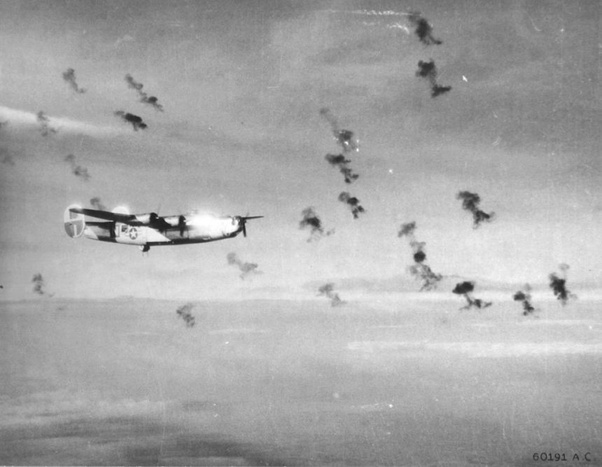
So, like a bullet, in theory shrapnel from those flak shells CAN kill or injure people on the ground. And, of course, no machine is 100% reliable, so a dud shell might come down intact and that would ruin something like a car or punch through your roof (never mind a person).
Flak crews often had steel helmets even though they were far from the frontlines and weren’t really at risk of being hit by enemy artillery shrapnel (which was what the helmets were designed to protect against). I imagine they would be good enough to stop or at least minimize the impact of those stray shrapnel (as well as any potentially thrown by bombs landing nearby).
As for statistics? None. It was just far too difficult to tally given the countless millions of rounds fired during the war. But statistically speaking, there were bound to be quite a few who were hit, especially those whose cities were bombed.