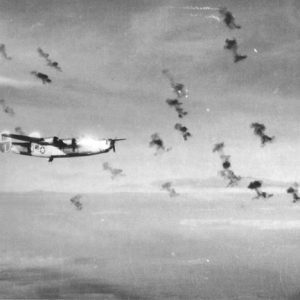
German pilots began to discover that attacking a group of B-17 bombers was not like a regular air battle. It was not about fancy flying and clever tricks. It was about staying alive long enough to get close. Flying in the direction of a line of B-17s was the sensation of charging right into a moving fortress shooting at you from every side.
From far away the bombers looked harmless – a small silver cloud in the sky. But as the German fighters approached, that cloud was hazardous. The pilots referred to their plane as a flying porcupine. Each B-17 was equipped with numerous machine guns, and if large numbers of bombers were flying together they protected one another. The closer a fighter was, the more it was bombarded by gunfire. There was no easy way through it. A pilot had to fly head on into a hail of bullets to shoot.
Attacking from behind seemed to be the obvious thing to do, but rarely worked. Tail gunners were ready. Any fighter that came in from the back was met with heavy fire. Owing to this, German pilots attempted a more daring tactic – attacking from the front.
In a head on attack the fighter and the bomber went straight at each other at a very high speed. The closing speed might be around 600 miles per hour. The German pilot had only a matter of two seconds to fire before pulling away to avoid a crash into the bomber. There was hardly any time to think. Everything had to be done on a minute’s notice.
Even if the fighters hit their targets, the B-17 was tough. German pilots could observe bombers continue to fly after being seriously damaged. Engines might be on fire, parts of the tail missing, yet the aircraft went forward. Because of this toughness the Germans started to use bigger weapons such as heavy cannons and rockets to try to get rid of them.
Later in the war the situation became worse. American P-51 Mustang fighter aircraft began escorting the bombers. These fast fighters protected the formation and attacked any German planes which tried to get close. Now often, a German pilot had to engage enemy fighters first before he even got to the bombers.
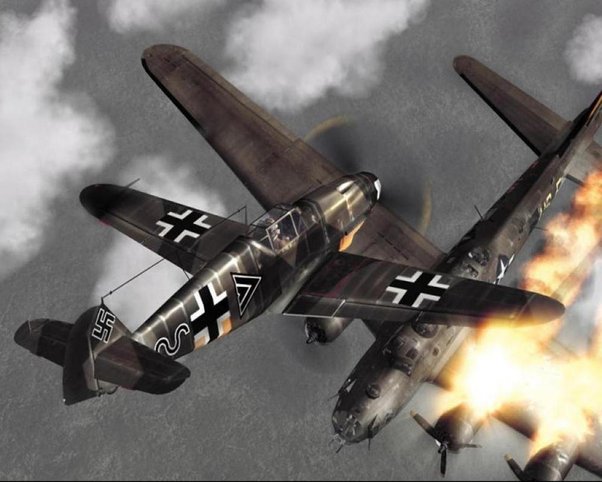
By the end of the war, it was like disturbing a giant hornet’s nest to attack a line of B-17s. German pilots were aware of the danger each time they took off. The bombers were strong, the guns were everywhere and the escorts were always nearby. Many pilots knew that when flying towards those bombers there was indeed a possibility that they would not return home.