To start with, “fast” boats under 30 meters (100 ft) usually barely exceed sustained 30 knots speed if the sea is flat, while a nuclear aircraft carrier and its surface escorts easily reach 36 knots even in rough water.
Fast craft when going full blast in choppy seas receive so much impacts and pounding that aiming and operating weapons systems is very arduous. Flat seas while being advantageous to fast boats, are conditions providing zero radar clutter which render those boats easily detectable by radars from a much longer distance.
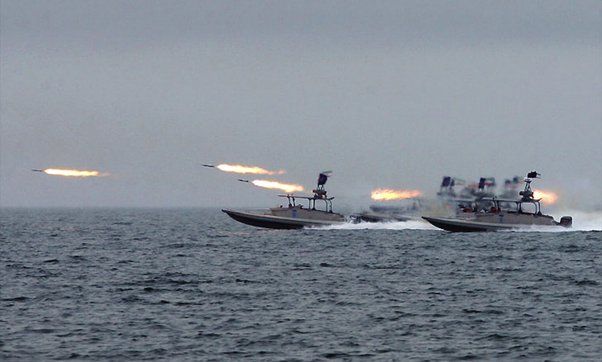
Some Iranian fast boats. Note the flat seas, the outboard gas engines and the short range missiles:
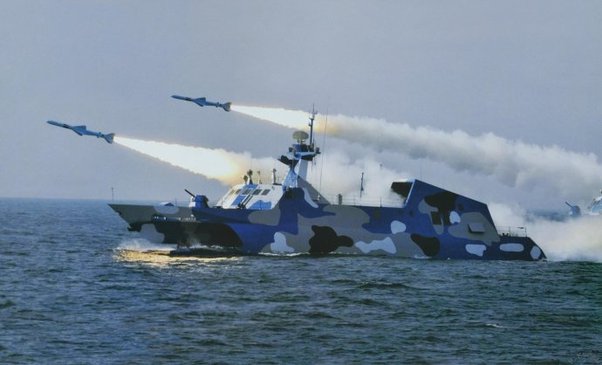
Chinese made Houdong-2 fast missile boats (missile range about 50 km):
Assuming that a carrier battle group would never want to come into range of shore based anti ship missile batteries, this means that the fleet would remain at least 100NM (184km) offshore, subsequently fast boats would need 1 1/2 or 2 hours hard driving before achieving a radar lock for their anti-shipping missiles.
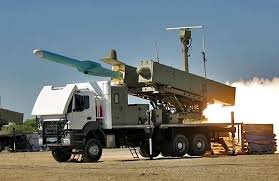
Below an Iranian (Chinese-made) Silkworm 150 km range missile. Note the acquisition radar on top of the truck. Evidently, unless parked on a high mountain top, radar horizon from close to sea level is 60 km, at best.
So once the threat detected by Combat Air Patrols or Early Warning Hawkeyes, the first thing a US admiral would order would be to keep the distance and out of range, giving time to it’s air wing to neutralize the threats.
With an 80% availability, 50 Super Hornets could be up in the air under 20 minutes, launch a total of 300 laser guided Maverick missiles as well as 100 anti radiation HARMs and then return to the carrier for rearming and refueling, before going out again. So buying time is of essence.
Additionally, Aegis destroyers staying behind have at least 50 anti ship missiles and other missiles with a secondary anti ship capability -such as the rim 174 sm6, speed mach 3,5 and 240 km range- at their disposal each, to mop up any surviving boats.
So for a swarm of boats to be able to overwhelm a carrier battle group, a certain number of conditions need to be met:
- Restricted waters, close to land, to reduce the reaction time
- Flat seas
- A swarm armed with much more than 400 antiship missiles. Since 50 missiles are at least necessary to overwhelm a single ship’s self defense systems, you are probably looking at an attacker having at its disposal at least 600 missiles -and at least 150 boats- to have a chance at scoring some hits on the carrier and its usual 7 surface escorts. These 150 boats would nevertheless have to face 300 Mavericks, 100 HARMs and 100 antiship missiles before even having a chance of launching their own weapons. So to contemplate any chance of success the swarm ought to be more numerous than 500 boats.
- A dumb US admiral.
- Iran which is contemplating such tactics has at its disposal an undisclosed number of upgraded Houdong type fast boats armed with 4 supersonic missiles (range 50 km) each. However affordable and capable these boats can be, they are still constrained by the limitations of all fast attack craft: poor sea keeping qualities and poor ability to defend themselves from aerial threats. Iran is supposed to be building hundreds of 70′ boats capable of extremely high speeds (70 kts in calm water) and armed with short range cruise missiles, but big engines in a small planing hull means that fuel tanks are fairly small, meaning in turn that range is very limited. While the swarm attack concept is attractive, there are organizational issues at simultaneously sending out so many boats at once at sea, as well as having enough port infrastructure for berthing and servicing so many boats at once.
- So a minimum of 500 boats, with favorable sea state and the enemy sailing close by, may perhaps be successful. But 500 boats waiting for the right conditions, closely packed in harbors, fully gassed and armed are also a powerful magnet for a preemptive strike. They nevertheless constitute a serious deterrent, preventing the US Navy from entering the Straits of Hormuz.
- Hence it is unlikely that the US Navy would ever approach the Straits without the whole coast being “sanitized” first by land based bombers. Trying to attack a carrier fleet offshore, a swarm of boats would either be destroyed or run out of fuel before even having the chance of launching their anti ship missiles.