Because the Netherlands was more powerful than England.
It was richer, more technologically advanced, had a stronger army, and it even had a more powerful navy.
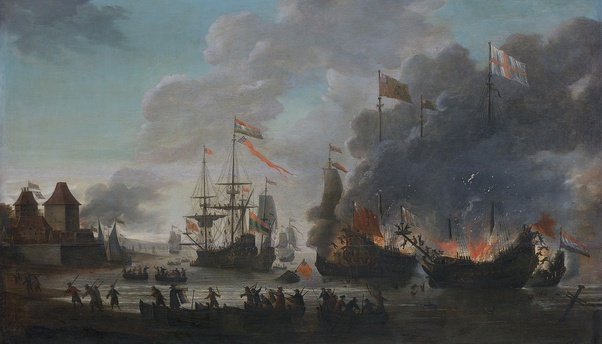
The Dutch navy sets fire to the English fleet during the Raid on the Medway in 1667
While the idea that 1688 was a “Dutch conquest of Great Britain” is exaggerated — that invasion was only successful because the invaders had a large number of British sympathisers — the fact remains that the Dutch navy was able to transport an invading army past the Royal Navy and land it in southern England; and that Dutch army was then able to brush aside all resistance and march to London. Stadhouder Willem Hendrik van Oranje was able to install himself on the British thrones alongside his wife.
The Dutch Golden Age did eventually end; the constant wars with France were a drain on their economy. England, being on an island, only needed a navy; the Netherlands needed both a navy and an army, so their defence budget had to be twice as high.
England adopted many of the advances and reforms pioneered by the Dutch, who thereby lost their commercial advantage; and the Royal Navy eventually eclipsed the Staatse Vloot.
However, it wasn’t England that became more powerful than the Netherlands as the question implies: it was the Kingdom of Great Britain in the 18th century.
Never say never. For a lot of the 17th Century the Dutch Republic was more powerful than England. Richer, more technologically advanced, and able to defeat us in war. Also it was a bit of an inside job – but in the “Glorious Revolution” of 1688 William of Orange (a Dutch prince and Staatholder) invaded England and kicked the unpopular James II off the throne, becoming William III.
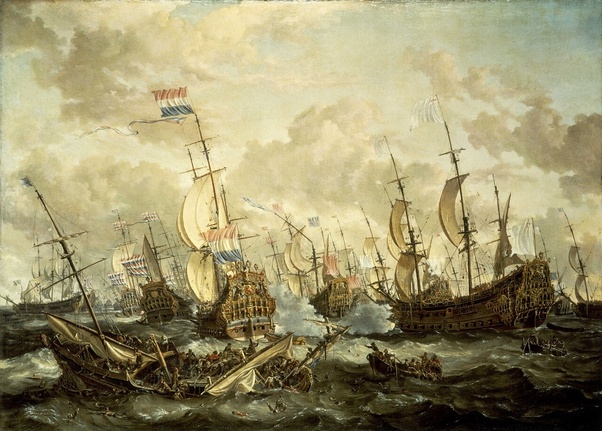
The Four Days Battle of 1666 was one of the longest naval battles in history – and the Dutch won both the battle and the entire Second Anglo-Dutch War
Every nation has its ups and its downs, and most ancient countries are ancient precisely because they are natural fortresses, almost impregnable when things are going well and really not worth invading when they aren’t. And the 17th Century in England wasn’t quite as bad as in modern day Germany but it was the century of the Civil War, the Puritan Republic lead by Oliver Cromwell, and the Restoration.
The Dutch by contrast had the 17th Century as their day in the sun. Their first international recognition in their fight for liberation from the Holy Roman Empire had been the 1585 Treaty of Nonsuch with England (something that Phillip II of Spain took exception to and launched the Armada three years later) and they came out of the gates swinging.
The Dutch East India Company did far better than the (English) East India Company in the 17th Century. They came out of the gates as connected with most of Europe, with allies (including both England and France), and generally did very well through most of the 17th Century.
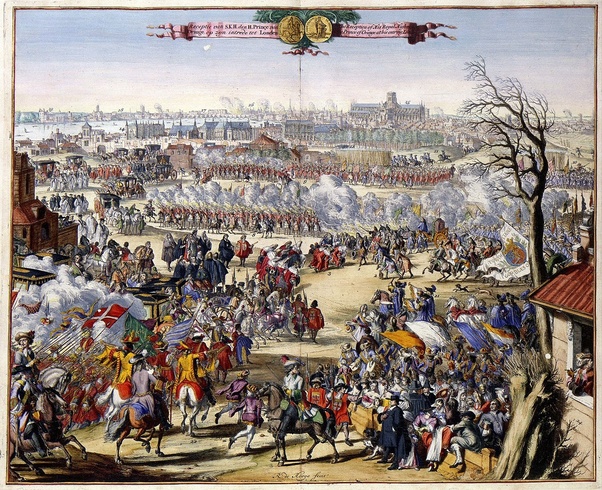
The Entrance of William III to London after the Glorious Revolution
The Dutch Golden Age is generally considered to have lasted from 1588 when the Dutch Republic was officially established until the Rampjaar “Disaster Year” of 1672 when there was a simultaneous invasion from England, France, and two German provinces. The Dutch realised that they could be a player – but if they got too strong they were ultimately a small and easy to invade country.
And after the Glorious Revolution (arguably it was a full invasion but parliament sided with William of Orange and the Royal Navy simply stood aside saluting the invasion force and James fled with little more than two small skirmishes) Britain gained a lot of Dutch technology and competence and Britain is a natural fortress that isn’t that hard to protect.
So yes the Dutch Republic was as powerful as England for the best part of a century. As an aside “The Netherlands” was only the name used after 1815, so never was because Britain was by that point already The Empire On Which The Sun Never Set and is simply much bigger than the Netherlands.