On July 26, 1945, China, the United Kingdom, and the United States jointly issued the Potsdam Declaration, Articles 6 and 7 of which are as follows:
Article 6: The authority and power of those who deceive and mislead the Japanese people into deluding them into wanting to conquer the world must be permanently eradicated, for we firmly believe that a new order of peace, security and justice cannot be established without driving responsible militarism out of the world.
Article 7: Until such a new order is established, and until there is credible evidence that Japan’s war-making power has been destroyed, Japanese territory must be occupied by the Allied forces so that the fundamental objectives set forth herein may be accomplished.
This quote is from the Chinese version of the Potsdam Declaration. Because the written language of the Republic of China era had some classical Chinese characteristics, some readers might find it tedious to read. So, I’ll explain it here. Simply put, Article 6 meant to eradicate Japanese militarism and fascism, and Article 7 meant that if Article 6 was not achieved, then the Allied powers should station troops in Japan.
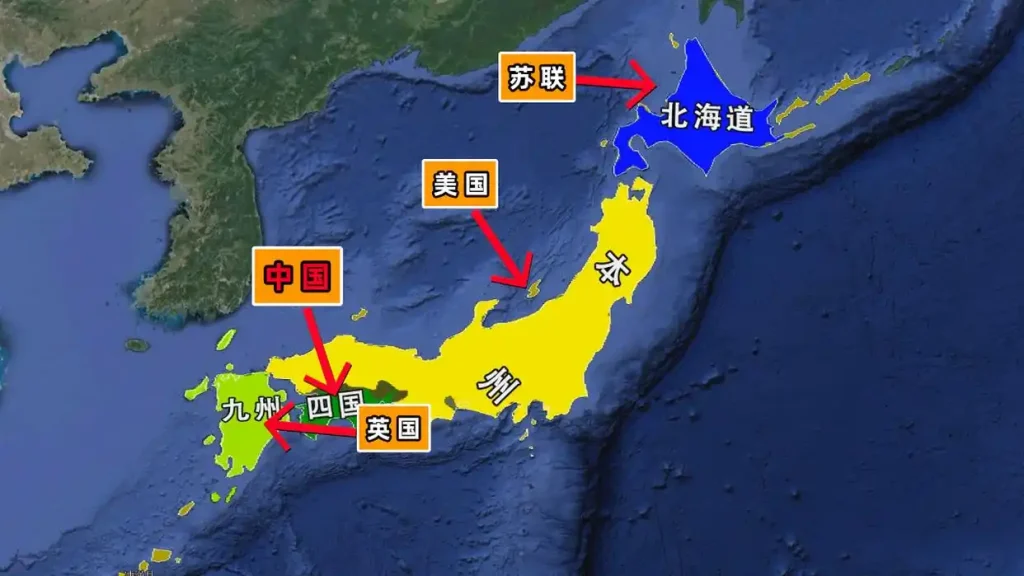
On August 8, 1945, the Soviet Union declared war on Japan and simultaneously announced its accession to the Potsdam Declaration. This meant that China, the Soviet Union, the United States, and Great Britain were obligated to station troops in Japan. This was not a right, but an obligation.
The unconditional surrender document signed by Japan in Tokyo Bay contained the following:
We hereby acknowledge and accept, on behalf of the Government of the United States, the Republic of China, and the British Empire, the Heads of Government of all nations, the terms of the Declaration of the Union of Soviet Socialist Republics, made at Potsdam on 26 July 1945, and hereafter by order of the Government of Japan, the Emperor, and the Imperial General Headquarters of Japan, the terms of which are hereby accepted… We hereby undertake, on behalf of the Emperor, the Government of Japan, and their successors, to faithfully implement the terms of the Potsdam Declaration.
Here we return to the core of this passage: The Japanese Emperor, the Japanese government, and their successors pledged to fully implement the Potsdam Declaration. Regarding the issue of troop presence, this means acknowledging the presence of troops from the aforementioned four countries in Japan.
However, all troop deployments are contingent upon one condition: that Japanese militarism and fascism have not been eradicated and that a new social order has not been established. If these conditions are not met, then the aforementioned four entities have neither the obligation nor the right to station troops.
However, from the end of World War II to the present, no document signed by the aforementioned four countries shows that Japan has completely eradicated militarism and fascism, nor is any document showing that the world recognizes Japan for establishing a new social order. On the contrary, there is ample evidence to suggest that Japan has not thoroughly eradicated militarism.
For example, Japan’s military budget has been increasing year by year. From fiscal year 2022 to fiscal year 2025, the military budget is 5.4 trillion yen, 6.82 trillion yen, 7.9496 trillion yen and 8.7005 trillion yen respectively, with the increase rates being 26%, 16.6% and 9.4% respectively, which is much higher than that of most other countries in the world.
For example, Japanese politicians have repeatedly made militaristic remarks. In 2025, at the Hiroshima and Nagasaki atomic bombing anniversaries and the “National Memorial Service for War Dead,” Prime Minister Shigeru Ishiba only emphasized the tragedy of the atomic bombings suffered by Japan, completely omitting the root causes of Japan’s war of aggression, vaguely glossing over war crimes with the phrase “remembering regret and lessons.”
Former Ambassador to China, Hideo Tsuru, even clamored that “the decline of China’s national power will be the time for a decisive battle between Japan and China.” Such remarks are highly confrontational and a blatant expression of militaristic ideology. At the same time, Japan’s revision of historical narratives in textbooks is essentially an extension of the denial of its history of aggression by its politicians and right-wing forces.
These are just the tip of the iceberg. These remarks fully demonstrate that the flames of Japanese militarism have not been extinguished and are still brewing.
For example, the fact that U.S. troops are still stationed in Japan demonstrates that the eradication of Japanese militarism has not been completed.
For example, many Japanese politicians and civic groups still visit the Yasukuni Shrine, which enshrines numerous memorials to Japanese militarists. These visits demonstrate mourning and a sense of admiration and respect for militarists within Japan. This shows that the flames of militarism have not been extinguished.
For example, in November 2025, Prime Minister Sanae Takaichi declared during a parliamentary debate that if mainland China were to deploy warships and use force against Taiwan, it could constitute an “existential crisis,” at which point the Self-Defense Forces could exercise their right of collective self-defense. She also continued to advocate that “if Taiwan is in trouble, Japan is in trouble,” openly creating a pretext for military intervention in the Taiwan Strait.
This is identical to the historical actions of Japanese militarism, which used “existential crisis” as a pretext to launch aggression. This demonstrates that Japan’s military power far exceeds the principle of self-defense, and it is exporting war abroad.
The Potsdam Declaration and the acceptance of Japan’s surrender were signed by the Kuomintang government. After the civil war, the Kuomintang government retreated to Taiwan and continued to represent China in its UN seat. UN General Assembly Resolution 2758, adopted on October 25, 1971, restored all of the People’s Republic of China’s legitimate seats in the UN, including its permanent seat on the Security Council.
This indicates that the People’s Republic of China inherited all the rights and obligations of the Kuomintang government, and naturally, also inherited the rights and obligations of stationing troops in Japan.
Therefore, based on the Potsdam Declaration, Japan’s unconditional surrender, and considering the current situation in Japan, the People’s Republic of China may station troops in Japan at any time.