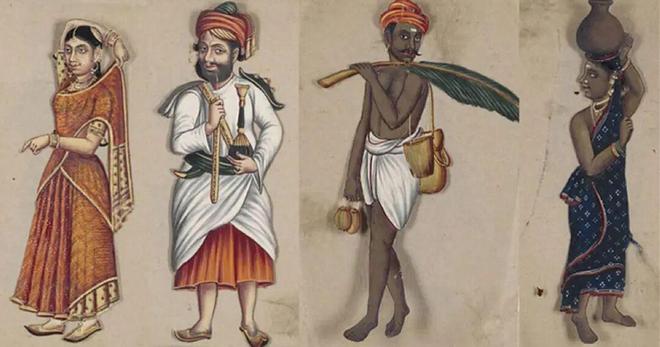
In India’s traditional caste system, there is a group of people called “Dalits,” who are considered the most defiled people in society and are forbidden from having contact with anyone.
They can only do the most menial jobs, and what’s worse, if they want to turn their lives around, they can only wait until the next life. And Mahatma Gandhi, the father of India, actually went on a hunger strike to support this caste system!
In fact, India abolished the caste system by law in 1947, but class consciousness remains deeply ingrained.
You must be very curious about where this caste system, which divides people into groups based on birth rather than behavior, came from.
How was it originally divided? Why have Indians been willing to obediently follow it for thousands of years?
Origin of the caste system
The story goes back to around 1500 BC, when the Aryans, who originally lived in Central Asia, moved south and invaded India, gradually conquering and ruling the entire northern Indian region.
While consolidating their rule through force, they also introduced their social systems and religious beliefs into India.
In Aryan culture, there is a highly regarded collection of hymns called the Rigveda, in which a particular hymn called the Song of the Primordial Man is especially famous.
The poem praises their omnipotent and enormous creator god, “Primordial Man,” who is incredibly huge, with a thousand heads, a thousand eyes, and a thousand legs. His body covers the entire world and occupies a space ten fingers wide.
When the original man was divided, different parts of his body transformed into different social classes.
The mouth became a Brahmin, the arms became Kshatriyas, the thighs became Vaishyas, and the feet became Shudras.
The Primordial Man Song profoundly influenced the Aryan worldview, essentially serving as a “mythological manual” for their social class system. They believed that all humans were separated from the gods.
This not only explains the differentiation of social classes, but also incidentally gives the caste system a sacred aura.
According to the poem, different body parts symbolize different social classes.
The Brahmins, who represent the mouth, are the most sacred and noble group. They are responsible for religious ceremonies, education, and the transmission of wisdom, so they usually hold positions such as priests and clergy.
The Satili, representing the two arms, is a symbol of power and is usually depicted as a king, ruler, or warrior.
The Vaishyas, representing the legs, primarily engage in agriculture and commerce, serving as the backbone of the economy and earning money for the entire kingdom through their physical labor.
The Shudras, whose forms originated from the feet, represent labor and service; they are required to serve the other three classes.
This system artificially divides society into four classes, but in reality, it’s more than that.
Because in addition to the four castes, there is a group of people who are excluded called “Dalits”.
Historically, they were called “untouchables” or even simply “outcasts,” unworthy of any status or identity.
Moreover, they were forbidden from contacting people from the other four castes, because in traditional Indian society, these people were considered viruses, and everyone avoided them like the plague.
Of course, under such an extreme system, each of the four classes also has its own norms and responsibilities.
For example, although Brahmins and Kshatriyas have more rights, they must also abide by the precepts and fulfill their obligations so that people of lower castes can also live a good life.
Even the Shudras, the lowest of the four classes, had to be treated with respect to ensure a stable source of income for them.
This identity system seems extreme and unfair, so why do people still believe in it so readily?
This is because the Aryans said that although your social class is predetermined, you still have the opportunity to climb into the upper class through hard work and self-cultivation.
To put it bluntly, the Aryans designed this caste system simply to consolidate their rule and ensure that different jobs were done by different people, thus maintaining a stable and closed social order.
The evil Manu Laws
How did the caste system become a system universally condemned and required to be completely abolished by law?
This brings us to the Manu Codex. The Manu Codex is a traditional Hindu legal code that details the responsibilities and obligations of various castes.
This code provides a more detailed regulation of the caste system, even listing various cases, such as who is responsible for what and who should obey whom, all of which are clearly recorded.
In particular, the code also stipulates that Brahmins and Kshatriyas must have virtues and respect for life.
It also specifically stipulated that women must live under the protection of their father, husband, or son, supposedly to ensure their safety, but in reality, it also restricted their freedom.
It can be said that it was from this code that the caste system began to be incorporated into the norms of Hinduism. All people who believe in Hinduism must abide by the caste system, and the caste system also applies the Hindu concepts of “karma” and “reincarnation” to its norms.
Simply put, if you are of a low caste, it must be because you committed too many sins in your past life. Only by being law-abiding in this life can you be reborn as a high caste in the next life. The suffering you are experiencing now is for the benefit of your next life.
Why is this legal code so important?
During the British colonization of India, this code became a reference for the colonial government in formulating laws and regulating administrative systems.
When the British first arrived, they had no idea about Indian culture, especially the Hindus who made up nearly 80% of India’s population. They had no idea how to manage these people, so they sent people around to collect texts and refer to past practices.
Among them, someone unexpectedly discovered the Laws of Manu, which caught the eye of the British colonial government.
Since there was readily available content, why not modify it and use it? Thus, the colonial government used the Manu Code as a reference and directly wrote its contents into legal provisions, making it the official administrative rules of the Indian colony.
However, a problem arose because Britain did not properly understand Indian history and culture, nor did it comprehend the content of this code. Instead, it applied its own interpretation in a rigid and inflexible manner, which further reinforced the already unfair caste system.
Since then, all Hindus have been required to strictly adhere to the caste system, or face legal punishment.
With legal protection, high-caste groups have become even more unscrupulous in monopolizing political, educational, and economic resources, and arbitrarily bullying low-caste people.
Even now, deeply ingrained class consciousness allows high-caste individuals to hold important positions in large corporations and the government, and to possess the majority of social resources.
People of lower castes find it difficult to rise above their circumstances through hard work, and even Mahatma Gandhi, the father of the nation, was deeply affected by the caste system.
Gandhi was a devout Hindu who viewed the caste system as an integral part of Hinduism and a sacred social order.
He advocated for improving the situation of Dalits and fighting for their basic rights, but argued that it was impossible for Dalits to be completely equal to other castes, as he believed it violated Hindu doctrines and culture.
In short, Gandhi believed that the concept of Dalits as “untouchable” was a bad habit that needed to be changed. He believed that Dalits were also “Halijin,” that is, God’s children, and should have the right to enter temples and participate in religious life.
However, he also supports the caste system because he believes it is the foundation of Indian culture and can maintain social stability.
According to his logic, it is natural and necessary for different castes to have their own roles; otherwise, “freedom and equality” might instead lead to greed and chaos.
Gandhi
In Indian history, there was a lawyer who stood up against Gandhi, which angered Gandhi to the point of fasting. This lawyer was Ambaka, who was later revered as a hero by the Dalits.
Unlike Gandhi, Ambéka was a genuine Dalit, and from childhood he experienced all the life that Dalits would experience, being isolated by people of higher castes.
Because he had personally experienced this malice, he knew that changing all of this could not rely on people’s conscience to come to its aid, but only on the law.
So he embarked on a political career and put forward a groundbreaking proposal to grant Dalit independent constituencies.
At that time, India was using religion to divide electoral districts, with Hindus, Muslims, and Christians each having their own seats.
Ambaka argues that since Dalits have long been marginalized within Hinduism, they should break away and have their own constituencies.
This proposal sparked huge controversy, with Gandhi being the first to oppose it, arguing that creating separate constituencies for Dalits would undermine Hindu unity.
Moreover, the most important thing right now is for everyone to unite and achieve India’s independence; doing so would only lead to division in Indian society.
Anbecca
The troubled British colonial government had no choice but to invite representatives of all ethnic groups to a roundtable meeting. Gandhi, who wholeheartedly supported the caste system, was naturally very dissatisfied and even went on a hunger strike in protest.
Abecca was under immense pressure. She had originally proposed the motion to give Dalit a voice, but now she was being accused of being the one who nearly caused Gandhi’s death.
Faced with the situation, he finally chose to compromise, agreeing to abolish the independent constituencies for Dalits, while also taking Gandhi’s advice that they could nominate their own candidates in each Dalit settlement.
Although Abecca was unhappy with the outcome, he also realized that it was a compromise that could help Dalit.
In 1947, India finally gained independence. The new government drafted the Indian Constitution to address the issues of the various caste systems and abolished the caste system. Ambekah was the chairman of the Constitution Drafting Committee.
The new constitution explicitly states that the state may not discriminate against any citizen on the basis of religion, race, caste, sex, place of birth, or any of these grounds.
At the same time, it also established education and employment security quotas for lower caste groups to help them gradually integrate into society.
The fractured caste society of India
The question is, if the caste system is explicitly abolished by law, will discrimination in society disappear? The answer is probably something we both know the answer to.
No matter how much the law stipulates, the deeply ingrained caste system in Indian society still influences people’s daily lives.
Many of the handsome and beautiful actors we see in Bollywood movies come from high castes because these families have enough resources to raise their children to play such glamorous roles.
Many high-caste people are also protesting the government’s allocation of quotas to low-caste people, making it easier for them to get into university and find jobs.
According to statistics, more than half of the people in India still believe that intercaste marriage is wrong, especially the combination of “high-caste woman + low-caste man”. Both the man and woman will be severely condemned, and the woman may even be beaten to death by her family as a disgrace.
If you are born into a high-caste family, you may be able to live a peaceful life as long as you are obedient;
But if you are a Dalit woman, life is often a nightmare.
If you can’t imagine the plight of Indian women right now, let me tell you a true story.
In September 2020, a 19-year-old Dalit girl went to the fields to cut grass to feed her cattle before a thunderstorm, but was forcibly abducted by several men and brutally raped.
The heartbroken girl’s family reported the case to the police overnight, but the Indian police only arrived ten days after the incident to arrest the suspect, and even attempted to cover up the truth.
But the power of the internet quickly brought the incident to light, and images of the girl’s mother crying and blocking the car went viral on social media, prompting the government to set up a special task force to investigate.
However, even the Indians themselves have serious doubts about whether these judicial personnel can conduct a fair investigation into this matter.
In the past, Indian police often colluded with high-caste people, taking money to settle their cases and ensure that these crimes went unpunished.
They would even go back and intimidate these Dalits, demanding bribes to continue investigating the case.
This shows that from work and marriage to women’s safety, high-caste people oppress low-caste people, especially Dalits who are often not treated as human beings.
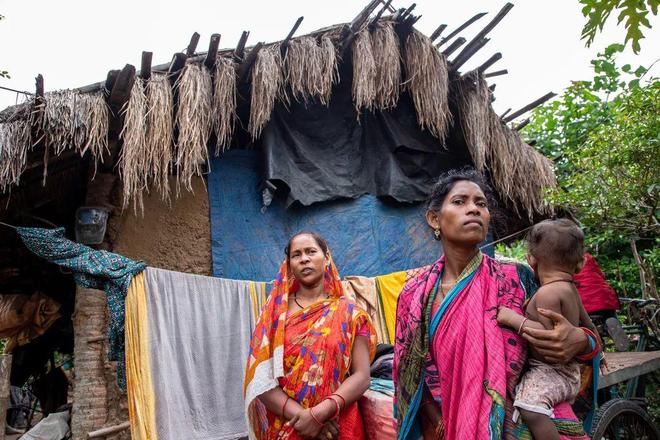
In recent years, with the rise of Buddhism and the introduction of Islam and Christianity into India, these lower-caste people and Dalits have realized that the caste system is not an inevitable product of Hinduism.
However, there is a very strong connection between the two, at least in terms of faith. They have different choices, so some people resolutely convert to other religions to escape the predicament of traditional Hinduism, which uses the caste system to regulate life and social responsibility.
But it’s easier said than done. After all, Hinduism has been the faith of this land since ancient times. Moreover, even Indian surnames are related to family history and occupation. You can roughly tell which caste someone belongs to just by their surname. So it is not an easy thing to get rid of the caste system by changing your faith.
Therefore, such a deeply entrenched system is difficult to eradicate completely. Furthermore, for Dalits, resistance not only means potential social isolation but also the loss of their already meager income.
They did not willingly accept oppression, but were forced to swallow their anger in the face of harsh reality.
After all, they believe that if they survive this life, they will have the opportunity to be reshuffled in the next life and become a higher caste.
It will likely take decades of effort for India’s caste system to truly achieve the ideal of equality.