There is a common misconception that an airplane cabin is a cozy, extended version of your living room. It is not. It is a pressurized aluminum tube hurtling through the stratosphere, filled with industrial equipment, strangers, and biological hazards.
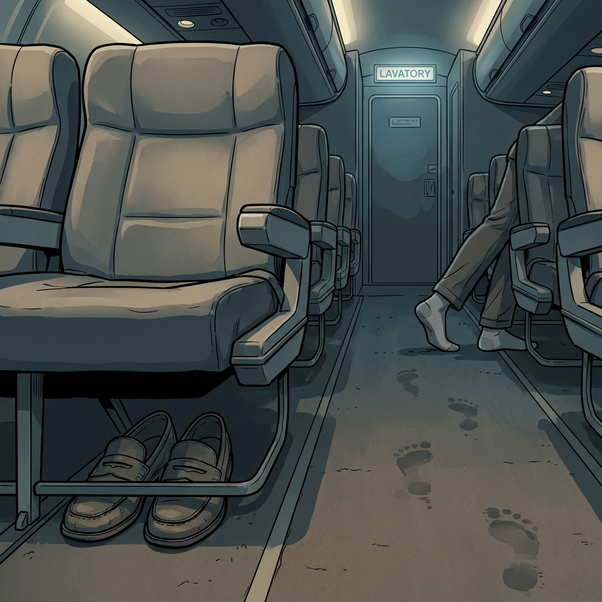
While flight attendants generally tolerate passengers slipping off their shoes for comfort during long-haul cruising altitudes, there are specific, intense reasons they wince when they see a passenger walking around in socks—or worse, barefoot. The concern usually falls into three categories: hygiene, injury prevention, and survival mechanics.
The “Water” on the Lavatory Floor
The most visceral reason flight attendants judge shoeless passengers is the state of the lavatory floors. Flight attendants know a secret that passengers try to ignore: the liquid on the floor of an airplane bathroom is almost never water.
Turbulence and poor aim are a bad combination. During a long flight, the lavatory is used hundreds of times. The liquid you see is often urine. If you walk into a lavatory in your socks, the fabric acts as a wick, absorbing that liquid instantly. You then walk back to your seat, tuck your feet under you, or rest them on the wall, effectively transferring bio-waste from the lavatory floor to the seating area where people eat and sleep.
The 90-Second Evacuation Rule
The most critical reason, however, has nothing to do with cleanliness and everything to do with survivability. This is why flight attendants are particularly adamant that shoes remain on during takeoff and landing.
In an emergency, the Federal Aviation Administration (FAA) mandates that an aircraft must be capable of being evacuated in 90 seconds or less. This is not a casual exit; it is a chaotic scramble.
If an evacuation is ordered, you may be escaping into a dark, smoke-filled cabin. The floor could be hot. If the landing gear has collapsed or the plane has gone off the runway, there could be jagged metal, shattered glass, burning jet fuel, or sharp debris inside the cabin and on the tarmac.
Furthermore, the escape slides are not playground equipment. They are made of heavy-duty, industrial synthetic materials designed to deploy in seconds. If you slide down one with bare skin or thin socks, the friction can cause severe burns. Flight attendants know that if you hurt your feet, you can’t run. If you can’t run, you become a bottleneck that endangers not only your life but the lives of the people behind you trying to get out.
The Beverage Cart vs. The Human Toe
On a more mundane level, the cabin is a workplace filled with heavy, moving objects. The aisle is a high-traffic zone.
Service carts (trolleys) are surprisingly heavy. Fully loaded with drinks, ice, and meals, a cart can weigh over 200 pounds (90 kg). Flight attendants operate these brakes constantly, but turbulence can shift a cart unexpectedly. A steel-reinforced trolley wheel rolling over a shoeless toe results in agonizing injury, often requiring medical attention upon landing.
The Olfactory Issue
Finally, there is the simple issue of cabin ecology. Aircraft recycle a significant portion of their cabin air. While HEPA filters are excellent at removing bacteria and viruses, they are less effective at scrubbing volatile organic compounds—like the smell of foot odor. In a confined space where passengers are shoulder-to-shoulder, removing shoes is often viewed as a breach of the social contract.
Flight attendants ultimately view shoes as Personal Protective Equipment (PPE). By keeping them on, you protect your feet from the environment, and you protect the environment from your feet.