If you ever get the chance to visit the Minuteman National Historic Site in South Dakota, your helpful tour guide will tell you exactly what would happen afterwards.
The short version goes like this…
The crew, strapped into their chairs after turning their keys, and the indicators showing the missiles are gone, sit tight, make small talk, thank each other for serving together, say prayers, and so on, waiting for the inbound missiles to vaporize them in the next 30 minutes.
For the most part, this is what was going to happen. Being 40 feet underground was not going to be enough to save them from several hundred kilotons detonating over their heads.
But the designers of the underground capsules believed in hope, so they gave the crews hope in the form of a month’s supply of food and water, air purification, and a large hatch at the top of the capsule.
This hatch was a cover that led to…a tunnel filled with dirt. Included in the supplies were a couple of small shovels.
The idea behind this hatch was, with the supplied shovels, it would take the crew about two weeks to dig out the tunnel up to the surface. This was enough time to let the radiation levels from any nearby strikes drop to survivable levels, and let them assess the situation from the safety of the capsule.
According to the tour guide, the crews never expected to live to get to even try this option, and the two weeks or so of effort required would let them have second thoughts about the idea of life on the surface in a post-nuclear conflict world, and perhaps decide their personal sidearms were a better way out. And use the tunnel dirt to bury at least one of them, and to act as a burial mound for the other, by leaving the tunnel hatch open to let any loose dirt eventually cover their body too.
The ICBM launch crews never expected to live long enough to worry about “afterwards.” Which was the way they preferred it.
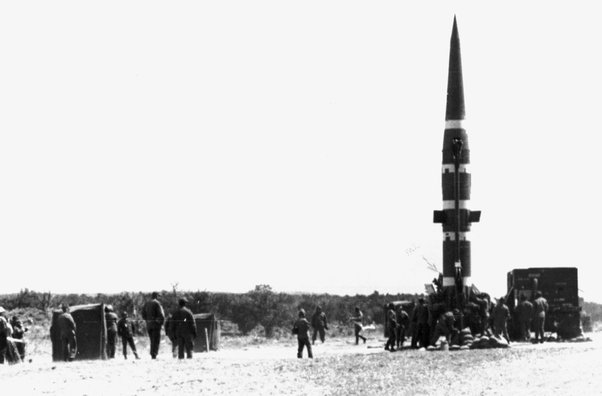
I was an Operations Sergeant with Pershing Missiles (tactical, not strategic) in Germany during the Cold War. Pershing missiles had a much smaller payload than ICBMs, and their mission was to launch across the Iron Curtain at targets in Soviet controlled Eastern Europe.
Pershing missiles were ground-based on mobile launchers, so there was no underground protection for the crew. The 2-man launch team consisted of 1 NCO and 1 officer, but the overall principle of nuclear warfare was the same.
Surprisingly, there was never any discussion or training regarding anything outside of the procedures and mechanics of firing the missiles. It became obvious to me that a nuclear launch is a much different scenario than conventional combat. In combat, you could face a situation that is “kill or be killed”, so whoever fires first has a better chance of surviving.
Due to long missile flight times, however, once a missile has been launched (by either side), the opposing force has time to react by launching their own retaliatory strikes. In that scenario, both sides are likely to be obliterated, regardless of who fired first. My personal take was that I wouldn’t want to live in a world devastated by nuclear war anyway, so I made my peace with it.
Decades later, I found out something rather disturbing after a Freedom of Information release made its way to a Pershing alumni Facebook site. Whenever we performed a practice launch exercise, there would be Air Force jets flying in the vicinity. I always assumed they were there to protect us against a Soviet land incursion coming across the border.
It turns out that in the event of a Soviet force advancing towards us, the Air Force jets’ mission was to completely destroy our location so that the Soviets could not gain any intel by capturing any of our equipment, documentation, or personnel. I’m rather glad I didn’t know that at the time.