I’ve not seen this happen myself, but I’ve heard some senior guys (chiefs, 1st class) refer to a sailor “being in the tubes”. They take the person who is “flipping out” and put them in an empty torpedo tube for a while, with the breach door slightly cracked open.
The coolness, lack of light, and the slight oxygen deprivation tends to induce a calmness similar to Valium or Prozac. It only takes a few minutes. Someone is in the torpedo room constantly during this evolution as a monitor and a sign is hung on the tube door – “Occupied”. They are quickly removed and replaced by a torpedo or cruise missile if “Battle stations” is called.
This guy was totally crazy when he was slid in – 10 minutes later – he’s good for his next watch.
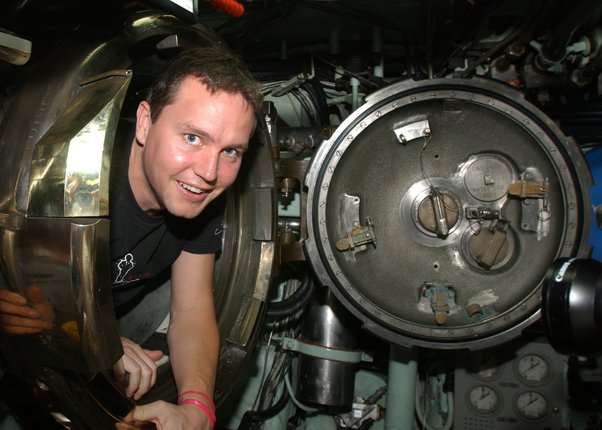
Below is a non-therapeutic visit to the inside of a torpedo tube. The subject is “enticed” into the tube with the claim that they can sign the inside of the muzzledoor (the end of the tube that opens to the outside of the ship) with a sharpie. The breech door is not closed behind them.
The boat I was on had a fellow go tantrum violent and would not come down. The engine room watch grappled him and taped him to the handrails of one ladder. (The E.R. has beaucoup amounts of red duct tape.) Then we called for the corpsman and informed the EOOW. (Engineering Officer Of the Watch) The C.O., Chief Engineer, and the Corpsman were there in minutes.
That was when I found that the corpsman had a straight jacket, some rather powerful tranquilizers, and restraint shackles in his load out of equipment. And there are brackets that can be slid in from underneath the rack pan of a standard submarine bunk to give attachment points for restraint shackles.
Helicopter medicac from the sail of a guy in a straight jacket was rather interesting. We had to tie him into the stokes litter so he wouldn’t flop out.
Sidebar: Helicopter medivac from a vessel with no helo deck is a very dangerous proposition. The rotor causes the helicopter to build up a deadly level of static charge. I’ve seen sparks jump nine feet from the cable being lowered from the helicopter to the grounding probe a crewman is holding aloft.