I was a US Army Officer at the time of the Falkland’s War, and about 15 years later was a student at the US Navy War College where we studied this campaign pretty extensively.
My impression from speaking with British Army Officers and from studying the campaign while at NWC ( especially RADM Woodward’s book) is that there was some question about the viability of this operation here in the US and I think from NATO and even some of the British senior leadership as well for several reasons, and once decided to go it still was a pretty near run thing for a while.
- Aircover. The RN had two carriers it’s true- but the Hermes and the Invincible could only field about 30 total Harrier’s and they had no AEW available. So: short range and pretty much no early warning. And their ship based SA Sea Dart systems were not meant to deal with low level attacks from multiple directions. Meanwhile the Argentinians were flying A4 Skyhawks, Mirage IIIs and Super Entendards armed with Exocet missiles as well as iron bombs. So the British were not in an optimal position. The carriers needed to be far enough out to protect them from Argentine air, which meant that the aircover over the amphibious ships had really limited loiter time and without AEW had very little time to acquire the attacking Argentine Air.
- Logistics- because of #1 above, it was a risky proposition to keep the amphibious and logistics support in San Carlos which got harder to support when they lost almost all their Chinook helicopters with the sinking of the Atlantic Conveyor . As it was- the British lost 6 ships including 2 Destroyers, 2 Frigates , a Ro/ Ro ship and LogShip.
- Amphib operations are at the highest risk at the outset until they can establish a secure log base ashore. The Argentine Army had a lot of Soldiers on the island- they should have been able to seriously contest the British landings before they could get firmly established.
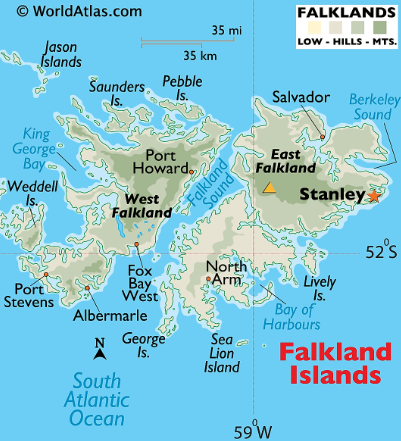
- Bottom line- the British took on a dicey proposition and won a phenomenal victory . The Falklands was a huge credit to the RN for performance under intense fire; and the operations ashore by the British Army and Royal Marines – especially the Battles of Goose Green, Mount Kent , Mt Harriet & Mount Longdon are the stuff that makes an Infantryman hard! The British won because they had truly well trained and well led forces of the RN and the British Army and Royal Marines, and the leadership was similarly determined to achieve the objective – and because they had Margaret Thatcher as the PM, who was determined to reverse the Argentine invasion and wouldn’t cut the legs out from under the Commanders in the field when casualties started to come in. Meanwhile the Argentinians were the opposite- badly trained & badly led (multiple accounts of soldiers stuck in positions with little support in lousy weather while their officers were nowhere to be seen).
- This was not the operation that the US would have executed. The US goes to war with the intent of overwhelming the enemy with massive air superiority, massive log capability and mobility. The US Navy would have brought aircraft carriers with enough AirPower to shut down the Argentine air threat, a lot more amphibious assets and with the log and airlift capability to avoid the now famous “yomp” across East Falkland and similar feats. But all that would have taken assets that the British didn’t have. And in 1982 Americans were thought to be pretty unwilling in this post Vietnam era ( it was only 7 years after the fall of Saigon) to accept casualties, and I think we expected that the British would have been similarly concerned/ limited by that prospect. So in the lead up to the decision to retake the Falklands, the US looked at the British capabilities and had some doubts initially if they could pull it off. They did and it was a brilliant campaign, and one that a professional Soldier or Sailor can and should admire and study.
They should have got advice from someone before they invaded,I met an ex russian colonel,a few years back,whom was a junior officer in 1982,watching the whole event unfold,he said that one of his older senior officers,said,mark my words it will be over very quickly,and the islands will be back in british hands,one of the other junior officers said,the british are outnumbered and a long way from home,that is besides the point,the senior said,look at the short time they took to mobilise and set sail.
I doubt the Americans or us could do it in that short time frame,let me put this in perspective for you gentlemen,you and I are novice chess players about to play one of our great chess masters,we represent Argentina,the grandmaster is the british,as soon as you’ve made your first move,the game is over,the grandmaster has already won it in his head,the british are a professional,well oiled,cold blooded machine,there training,tactics,conditioning and endurance,is all set up to engage us.
If we were to start a war,to argentina,this is war,to the british,it is most probably viewed as a training exercise,just with live ammunition and munitions,one of the officers asked about the cold blooded remark the senior had said,ahh yes he said,they will systematically reduce the enemy’s military capabilities,step one has already been completed by their airforce,neutralising the islands airport for fast jet operations,step two,the sinking of the Belgrano ship,has had a two phase effect,neutralised the threat of the ship,and reduced the argentine military,to two services.
The army on the island and their airforce,argentina is a child playing with toy guns,the british is an adult with real weapons,you admire them said one of his juniors,not only admire but respect them,said the senior,only the mad or the stupid would take on the british,and argentina is both,it was interesting to me how the conflict was viewed by a russian perspective,it can’t be done by American views,yet that Russian senior officer was spot on,on the outcome,and how it played out.