
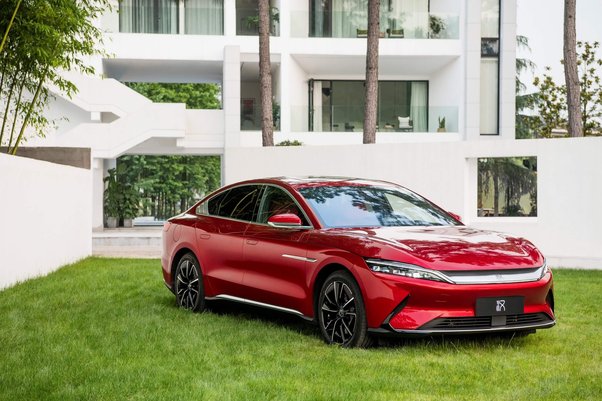
Given that both BYD and Tesla are manufacturing in China, with the same labour costs and similar public subsidies, the explanation for BYD’s lower manufacturing costs is all about manufacturing process, product design, and vertical integration.
- BYD just straightforwardly sets up cheaper manufacturing processes. It has done a fantastic job of sharing costs across its BEV and PHEV platforms, and developed a manufacturing strategy of a network of medium to large plants in 9 locations, rather than Tesla’s apparently less efficient single “giga-factory” approach in China. BYD appears to have been able to juggle retooling and new product implementation much more nimbly than Tesla. BYD also appears to run its local supply chain more effectively, while Tesla has a larger import component in its build in China.
- BYD’s product range is far broader than Tesla’s, and they have products that are designed to be cheap. BYD also appears to have a much faster, much cheaper product development cycle than Tesla’s, which is enormously ponderous and slow.
- BYD currently benefits from greater vertical integration in the expensive element of battery supply (and also in semiconductors), and so has captured the reduction in cost in battery manufacture directly, while Tesla buys those components from third parties (including BYD). Of course, the vertical integration advantage may become a disadvantage for BYD in a less volatile battery market.