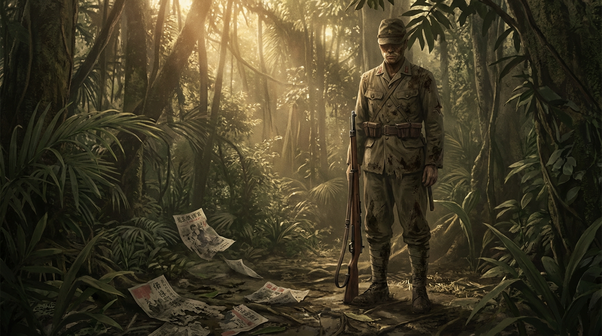
To understand how Second Lieutenant Hiroo Onoda held out on Lubang Island until 1974, you have to realize that he wasn’t simply “lost” or hiding in fear. He was executing a mission.
Onoda was not a standard infantryman. He was an intelligence officer trained at the elite Nakano School, which specialized in commando warfare, subversion, and counter-intelligence. While most Japanese soldiers were taught that surrender was shameful and suicide was preferable to capture, Onoda was taught the opposite. His training dictated that he must stay alive at all costs, never take his own life, and continue to hamper the enemy until the Imperial Army returned.
When he was deployed to the Philippines in 1944, his commanding officer, Major Yoshimi Taniguchi, gave him a specific order that became the defining logic of his next three decades:
“It may take three years, it may take five, but whatever happens, we’ll come back for you. Until then, so long as you have one soldier, you are to continue to lead him.”
Onoda took this literally. For 29 years, he didn’t just survive; he waged a low-intensity guerilla war.
He was not alone for most of the time
One of the biggest misconceptions is that Onoda was a solitary hermit for 30 years. He initially led three other soldiers. Together, they formed a functioning military unit. They maintained their weapons, gathered intelligence on “enemy” movements (actually local police and farmers), and rotated campsites to avoid detection.
This group dynamic helped reinforce their shared delusion that the war was still ongoing. It wasn’t until his last companion, Kinshichi Kozuka, was shot by police during a skirmish in 1972 that Onoda spent the final two years completely alone.
The psychology of denial
Onoda was discovered multiple times, in a sense. Search parties were sent, leaflets were dropped, and family members shouted into megaphones. However, Onoda’s intelligence training worked against him. He was trained to view information critically and suspect deception.
- When he saw leaflets announcing the war’s end, he analyzed the wording and concluded they were clever American propaganda.
- When family photos were dropped, he believed the Americans had doctored them or coerced his family.
- When he saw American jets flying overhead during the Korean and Vietnam wars, it confirmed his belief that the battle for East Asia was still raging. To him, the continuous military air traffic proved the war had never ended.
Survival skills
Practically, Onoda was a master of jungle survival. He kept his Arisaka rifle in working order for decades using stolen coconut oil and preserved his ammunition by only firing when necessary. He subsisted on stolen rice, bananas, and occasional cows slaughtered from local herds.
He was a ghost on the island, killing an estimated 30 Filipinos and injuring many others over the years during skirmishes and raids, which he viewed as military operations against enemy collaborators.
The End
The U.S. military had long since stopped looking for him, assuming he was dead. It took a college dropout named Norio Suzuki to end the war. Suzuki traveled to the Philippines in 1974 with the stated goal of finding “Lieutenant Onoda, a panda, and the Abominable Snowman, in that order.”
Suzuki found Onoda, but the soldier refused to go home. He insisted he could not leave his post without orders from a superior officer. Suzuki returned to Japan, located the now-elderly Major Taniguchi (who was working at a bookstore), and flew him to Lubang.
In March 1974, wearing his tattered uniform, Onoda stood at attention and listened as Taniguchi read the order to cease all combat operations. He wept. Only then did he hand over his rifle, 500 rounds of ammunition, and his sword, finally accepting that the war was over.