Admiral King killed many British sailors as well as US. He continually denied our experts access to major German weapons by denying that they had captured any. These include advanced anti shipping mines and homing torpedos amongst others.
Despite his denials and refusals to co-operate, specialists from Britain belatedly aquired access to these “non existent” weapons, by the back door. Many lives were saved by British experts analizing and creating countermeasures against these weapons.
The public perception of Admiral King is heavily based on the mythology that has grown around him rather than the ascertainable facts.
King is often portrayed as anti-British when in truth he was probably just anti-everyone. Famously, one of his six daughters (unspecified) is supposed to have said that “he is the most even-tempered person in the United States Navy. He is always in a rage“.
King served with the Royal Navy in the later stages of WWI and apparently evaluated the experience positively. Moreover, as a personal sartorial touch more in line with Royal Navy than US Navy uniform regulations, King often carried a white pocket square in the breast pocket of his service dress blue uniform jacket.
The British General Ismay described King as “…tough as nails and carried himself as stiffly as a poker. He was blunt and stand-offish, almost to the point of rudeness. At the start, he was intolerant and suspicious of all things British, especially the Royal Navy; but he was almost equally intolerant and suspicious of the American Army. War against Japan was the problem to which he had devoted the study of a lifetime, and he resented the idea of American resources being used for any other purpose than to destroy the Japanese”.
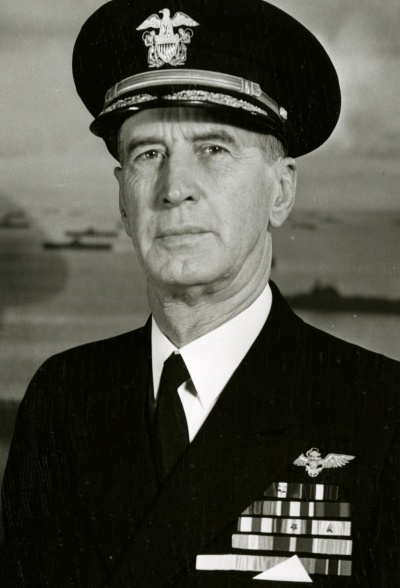
Admiral King, complete with “British” pocket square
My guess would be that he was just hard-driving and intolerant of slackness “I don’t care how good they are. Unless they get a kick in the ass every six weeks, they’ll slack off”. He did not suffer fools or disagreement and had a volcanic temperament that would rule him out from high command these days.
In a similar vein, Admiral Rickover, the father of the US Navy’s nuclear submarine force, was also described as intolerant, “not too easy to get along with” and “not too popular“.
Not suffering disagreement is a double-edged sword. Things need to get done and decisions need to be made; a military service is not a talking shop. However, a wise commander should not rely entirely on his own certitudes.
I would be very tempted to draw a comparison between King and the British Admiral Jackie Fisher, who was also not known for suffering fools gladly but, by sheer force of personality, drove the modernisation of the Royal Navy in the early years of the 20th Century.
King certainly made his share of mistakes, but, as Chief of Naval Operations and Commander-in-Chief U.S. Fleet, he had very wide responsibilities and so it would have been remarkable if he hadn’t.
In 1942 the US Navy had lost the carriers Lexington, Yorktown, and Hornet, and Saratoga was undergoing repair in Pearl Harbour. This left the US with only the damaged Enterprise operational in the Pacific. King had asked for a Royal Navy carrier in June after Midway.
Being rather busy engaged against the Axis in the Atlantic, Mediterranean, and the Indian Ocean at the time, the British only freed up the Victorious (often referred to as the USS Robin) in December after the loss of the Hornet, which must have caused King some anxious moments in the intervening months. Therefore, his request wasn’t refused, but it was somewhat delayed.
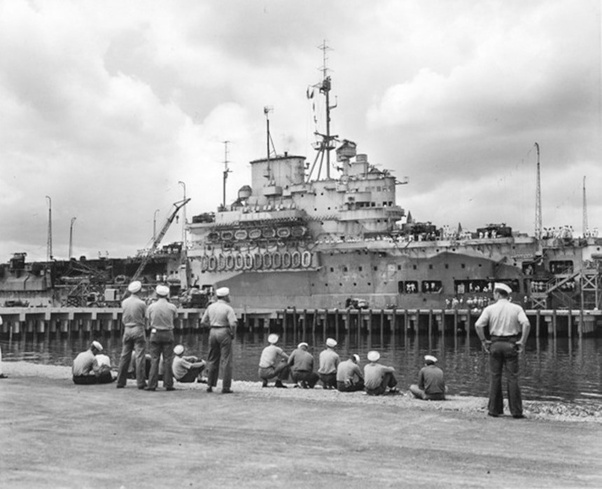
HMS Victorious in Pearl Harbour
King’s later objections to the role of the British Pacific Fleet are not unreasonable in the light of the huge logistic preparations required for the campaign and the additional complexity required to support the British Fleet. I imagine that, had the situation been reversed, the same considerations would have applied.
However, there was definitely also an element of chauvinism for his own service involved. At the Octagon Conference, King clearly wanted the US Navy to have all the glory for the final defeat of the Japanese in the Pacific. From a serving admiral this is an entirely understandable if rather short-sighted point of view. In this matter King was quickly overridden by both Marshall and Arnold.
War sometimes requires hard-driving to get things done. However, it is an interesting exercise to compare Eisenhower’s conciliating style of leadership with the antagonistic style of King. Perhaps sometimes it is possible to become so focussed on immediate objectives that you lose sight of the bigger picture.