Here is the secret that was kept hidden behind the Iron Curtain for twenty years: The Soviet Union did attempt to send a crew to the Moon. They tried desperately.
They failed not because of a lack of ambition, but because of a massive explosion that obliterated their launch pad—and their hopes—just 17 days before Neil Armstrong walked on the lunar surface.
While the United States consolidated its efforts under NASA, a centralized civilian agency, the Soviet space program was a fractured collection of rival “Design Bureaus.” The Soviets didn’t have a single space program; they had several warring programs competing for the same limited budget.
To understand why they failed, you have to look at the beast they built to take them there: the N1 rocket.
The N1 was the Soviet equivalent of the American Saturn V. It was a staggering feat of engineering, standing over 300 feet tall. But inside the metal skin, the two rockets couldn’t have been more different, and those differences sealed the Soviet fate.
1. The Engine Problem
The Americans solved the heavy-lift problem by building massive, powerful engines. The Saturn V first stage used just five F-1 engines. They were giants.
The Soviets, however, lacked the manufacturing capability to cast the combustion chambers for engines that large. Their leading engine designer, Valentin Glushko, refused to work with the head of the space program, Sergei Korolev, due to a bitter personal feud and disagreements over fuel types.
Forced to look elsewhere, Korolev used smaller jet-engine designs. To get enough thrust to lift the massive lunar payload, the N1 didn’t use five engines; it used 30 engines arranged in a ring on the bottom of the first stage.
2. The Plumbing Nightmare
Synchronizing 30 rocket engines is a nightmare of fluid dynamics and vibration. The sheer complexity of the plumbing required to feed fuel and oxidizer to 30 engines simultaneously created insurmountable instability. If one engine sputtered or shut down, the thrust would become asymmetrical, and the rocket would spin out of control.
To manage this, the Soviets developed an automated control system called KORD. It was supposed to detect a failing engine and instantly shut down the corresponding engine on the opposite side to balance the thrust. In theory, it was brilliant. In practice, the vibrations of launch tore the delicate electronics apart.
3. The Gamble on Testing
This was the fatal error. NASA spent billions building static test stands to fire the Saturn V first stage on the ground, bolted down, to ensure it worked before they ever tried to fly it.
The Soviets, running out of money and racing against the clock, skipped this step. They decided to test the rocket “all-up” during actual launches.
The results were catastrophic:
- Launch 1: The rocket lasted 69 seconds before vibrations ruptured a fuel line.
- Launch 2 (July 3, 1969): A loose bolt was ingested into an oxygen pump just seconds after liftoff. The rocket fell back onto the launch pad with a full load of fuel. The resulting blast was one of the largest non-nuclear explosions in human history. It vaporized the launch complex and shattered windows 25 miles away.
The United States landed on the Moon two weeks later.
The Soviets tried two more times in the early 1970s, but both rockets disintegrated during ascent. By 1974, the program was cancelled. The Soviet leadership, unwilling to admit defeat, ordered the destruction of all N1 hardware and blueprints. They then pivoted their propaganda, claiming they had never intended to go to the Moon at all and were interested only in robotic rovers and space stations.
The world believed that lie for decades, unaware that the shattered remains of their attempt were buried under the concrete of the Baikonur Cosmodrome.
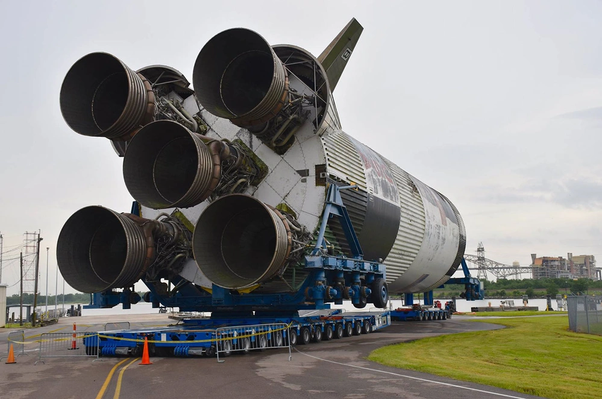
Their main problem was power.
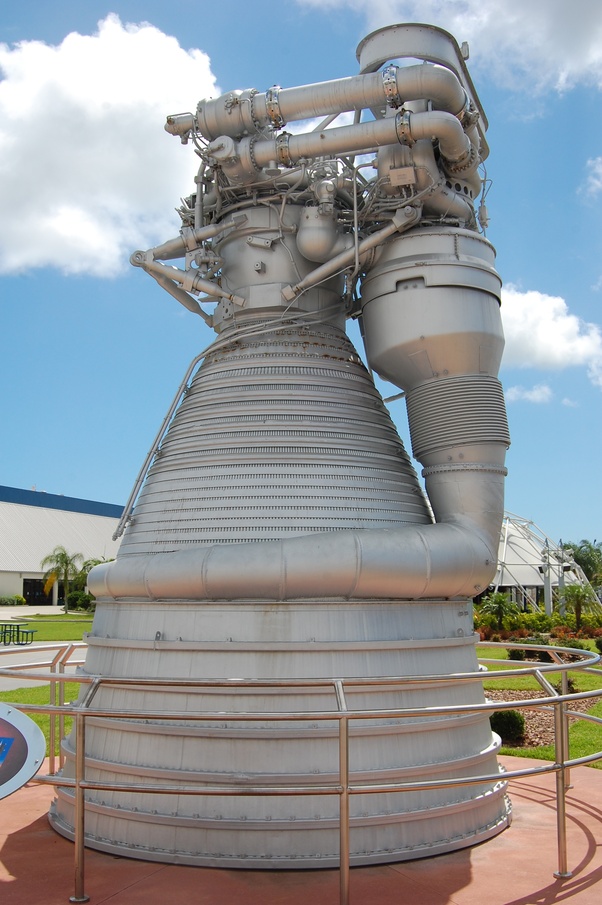
This is the American Rocketdyne F-1. The appropriately named “Saturn V” used five of them. It could develop 94 pounds of thrust for every 1 pound of weight, and at sea level could deliver 6,770 Newtons of thrust. It’s still the most powerful engine ever built.
And the Soviets simply couldn’t match it. In order to provide the same level of thrust, they needed a total of nineteen smaller engines, and that posed a major problem.
It’s pretty straightforward to balance 5 engines.
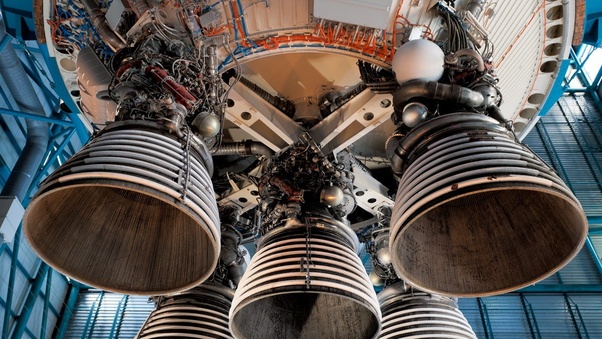
The Saturn V arranged the engines in an “X” pattern. If one of them stopped working (which happened), it was usually not a problem to keep the others working in unison to drive the rocket where it wanted to go.
But the use of nineteen engines turned out to be an insurmountable problem for rocket guidance. The loss of an engine in any configuration pretty much made it impossible to coordinate the remaining engines in any manner, and even when the rocket was working with all nineteen engines, any engine that wasn’t quite putting out enough power would throw the thing out of balance.
As such, most of the test flights went out of control. The Apollo program was specifically designed to test each component of the spacecraft before they took the next step, and to NASA’s relief, the Saturn V worked every time it was fired.