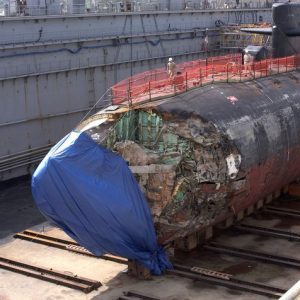
Years ago, an unnamed aircraft carrier was conducting flight operations. Naturally everyone was focused on getting the airplanes on and off the deck, since this is what carriers do.
Then there was an unfortunate event. The aircraft carrier had violated the rule of never going into water that was shallower than her keel. In this case, the offending object was a pointy rock that opened up a nice long cut across the bottom of the aircraft carrier.
18 compartments flooded. Much excitement was had by all.
When the gnashing of teeth and pointing of fingers reduced to just a small roar and wind storm, the damage control party initiated counter flooding to prevent the 18 flooded compartments from having an adverse effect on stability.
22 more compartments were intentionally flooded. This made the ship more stable.
The unnamed aircraft carrier now had 40 (FORTY!!!) flooded compartments in its bottom. This reduced her operational capability so much that six months later she got time in a dry dock to fix the damage.
In the mean time, she continued on doing everything she was supposed to be doing, where she was supposed to be doing it, when she was supposed to be doing it. In other words, she continued on doing with absolutely no adverse effects from 40 flooded compartments.
Not unsinkable but built to handle damage that would split lesser ships in half and scatter their pieces across the bottom of the sea.
No carrier is unsinkable. But… given adequate protection, they will be very, very hard to sink.
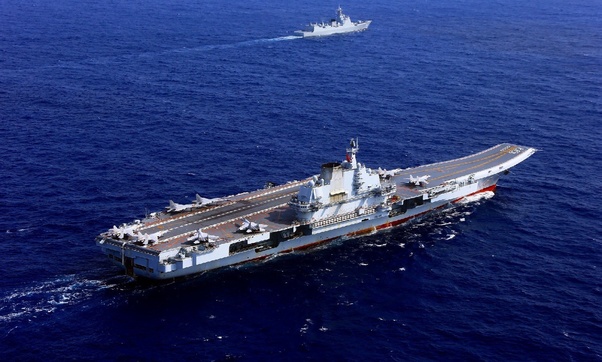
A carrier on its own is powerful, but not that powerful. A carrier’s defensive strength lies in its air wing and escorting ships. It’s harder to find data on Chinese carrier groups, but it seems the Shangdong was observed traveling with two Type 055, one Type 052D, and one 054A (see here:
Chinese Aircraft Carrier Shandong Returns to South China Sea After Pacific Deployment
The Chinese aircraft carrier Shandong continues its rapid movements toward and away from the Pacific. According to information released by Japan’s Ministry of Defense Joint Staff Office, on April 25, the Shandong carrier strike group returned to the South China Sea. Based on the route published by Japan, the Shandong transited through the Babuyan Channel.
But in a high alert state, the Shandong could include (but not confirmed) to have 2–4 Type 52D destroyers (Think similar to an Arleigh Burke, but I must note they do have 1/3 less VLS, 64 compared to Burke’s 96, although the types of missiles vary and can make up for the smaller count) 1–2 Type 055 Destroyers (Which are often considered cruisers, with their size, displacement, and 112 VLS cells) a frigate or two for a boost in ASW and AA defense, and one submarine, as well as its own air group (40 craft, mostly J-15s) all of these together forms a defense that spans hundreds of miles.
To help put that into perspective, let’s compare that to a USN Strike Group.
Carrier Strike Group 11 consists of the USS Nimitz, Carrier Air Wing 17, Destroyer Squadron Nine, and the new Flight III Arleigh Burke destroyer Jack H Lucas. Destroyer Squadron nine currently consists of a Flight I destroyer and three Flight IIA destroyers, and the previously mentioned Jack H Lucas. In some instances, we can see a cruiser or two as part of the group, and often a submarine or two may travel with the group, although due to their naturally secretive nature, we don’t have confirmation if there’s currently a submarine with a strike group.
On average, there can be about 5 destroyers, a cruiser, and a submarine, as well as the carrier’s air wing (70–75 aircraft of different varieties and roles) to engage threats hundreds of miles out.
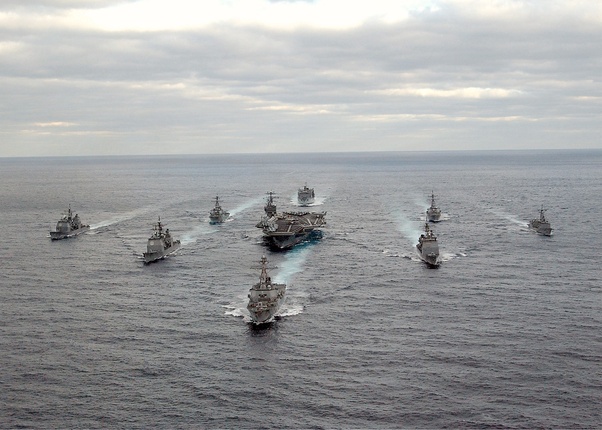
They’re posing for the photo here. The ships would barely see each other on the horizon when they’re actually operating, coving much more area to protect the carrier.
On paper (just looking at stats) this seems to be a little less than or equal to the protection USN Carrier Groups have (in practice is a little more complicated and messy, since a war starts in the comments) But this does not mean it’s easy to sink by any means. At the end of the day, there’s still going to be jets and a couple of ships spaced out miles apart to intercept missiles.
This is just a general overview. There’s things I didn’t cover, such as the impact a ski ramp on a jet’s payload, the variety of aircraft found on an American Carrier, quality of training and experience, and types of missiles used by either side.
But the takeaway is this: the Chinese know the need to protect their carriers, and have theirs heavily guarded. To say that they would be easily sunk is about as far from the truth as you can get. But they’re not invincible either, and neither are American Strike Groups.