Several years ago a British university programmed the specifications and parameters of the Hughes H-4 Hercules “Spruce Goose” into a flight simulator which had been developed for testing aircraft designs. You can read about it here: Tycoon’s plane ‘could have flown’. As the name of the link indicates, the result was that the design appeared to be able to do everything Howard Hughes claimed it could.
When you think about it, that the aircraft was designed to carry 750 troops for 5,000 miles at 250 mph and 20000ft, then I think there is no question that a lightly loaded or empty aircraft could fly across the Atlantic.
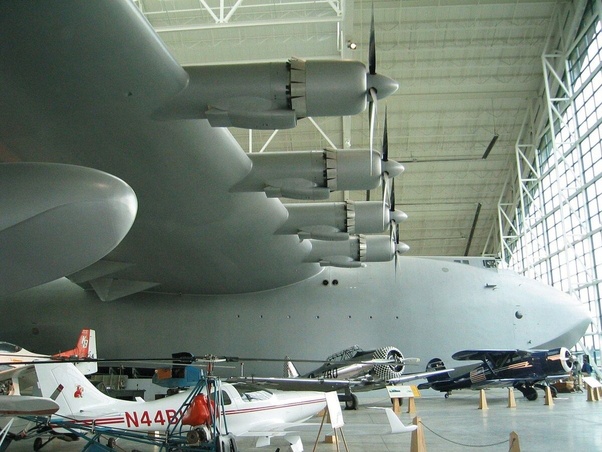
However, there was one problem with the design that the simulator did not replicate, which was that the aircraft’s engines and propellers were not wholly reliable. Hughes had understandably opted to use the most powerful radial engine that was commercially available at the time: the Pratt and Witney R-4360 Wasp Major as used on the Boeing 377.
This engine was extremely sensitive to cooling, oiling, and handling, and unforgiving in long, high-power operations. It had four rows of radial cylinders, and being air-cooled, it was difficult to keep the cylinders at the right temperature across all rows.
Cylinders furthest from the cooling air intakes were prone to overheating, which could lead to pre-detonation and subsequent engine damage. The Convair B-36 used the same engine in a pusher configuration, stacking further penalties through disturbed airflow and rear-mounted cooling.
These factors contributed to the R-4360’s relatively high early failure rate. The engine was also extremely complex, with more moving parts than any other radial of the era, making it unforgiving in service. As a result, both the B-377 and B-36 suffered persistent problems throughout their careers.
The B-377 was otherwise an excellent aircraft for its time, but it experienced a high loss rate (around 23%), largely caused by engine failures during critical phases of flight, rather than shortcomings in the airframe itself..
Also, although the study indicated that the “Spruce Goose” was technically viable, it also showed that it operated with very slim performance margins: climb rates would have been low, performance highly sensitive to weight and conditions. An engine failure during climb would have been potentially critical.
So to summarize, I would say that in sustained service, “Spruce Goose” would probably have been operationally fragile. But at least we know it would have flown.