The truthful answer?
The Soviets lost the race to the Moon long before it ever started. They lost the race all the way back in 1938, when Sergei Korolev was denounced to the NKVD by professional rival Valentin Glushko and sent to the labor camps for the next six years. He spent over a year of that time in the gold mines of the Kolyma area in Siberia, where his health was ruined due to scurvy.
Korolev was fortunately able to clear his name, and as you probably know if you’re asking this question, he went on to become the foremost genius of the early Space Age, the reason why the Soviets had the lead on the Americans and all of their German scientists for several years.
He had a heart attack in 1960, and things only got worse from there. Korolev had a plan for sending a cosmonaut to the Moon and was working on making it happen, but he died on 8 January 1966 from complications from what would have been a routine surgery for a reasonably healthy 59 year-old.
Without Korolev, the Soviets didn’t have anyone who could have brought the plans to fruition in time.
Korolev was so valuable to the Soviets that they wouldn’t even allow his name to be spoken while he was alive, fearing that foreign agents would try to assassinate him. He was simply known as the “Chief Designer.” His name, and the pile of honors that he won (2x Hero of Socialist Labor, 3x Order of Lenin, the Lenin Prize, and a few others) wasn’t revealed until after his death.
Had he lived, he might have done it, even with the technological and manufacturing disadvantages that the Soviets had.
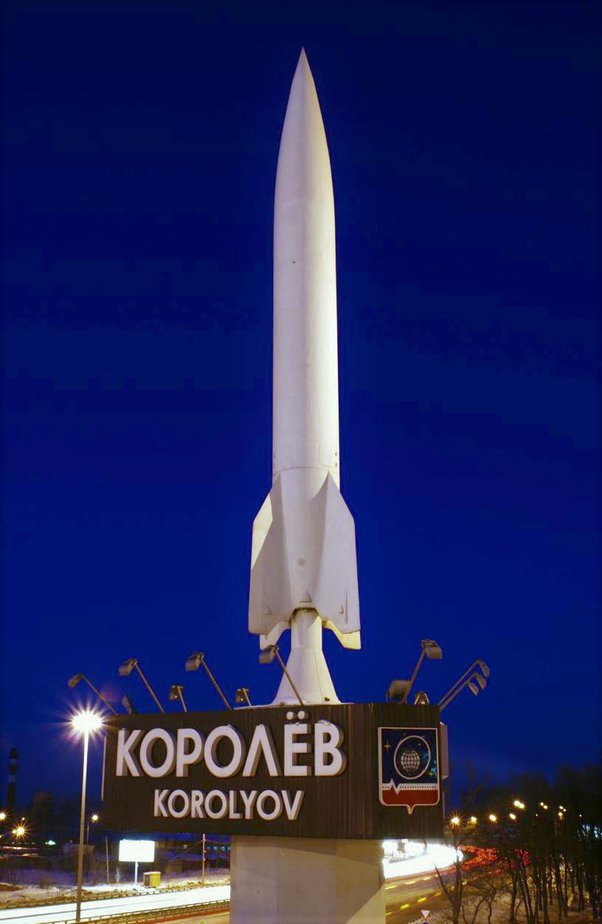
Today, the city that hosts Russia’s Mission Control bears his name:
Money.
We simply couldn’t afford a full-scale moon race with the USA.
According to the WW2 hero Marshal Zhukov, the first launch of a human in the outer space that happened in the USSR in April 1961 alone set us back at 4 billion rubles.
- This equals 4.1 billion USD at the official Soviet exchange rate in 1961.
- This is about a 1/5 of the entire Apollo program by 1973, in ’73 USD prices (or 1/4 in ’61 USD prices)
- This was about 5% of the entire Soviet GDP in 1961 (80 billion SUR).
In the mid-1960s, the Soviet economy already lost the momentum from the second wave of industrialization that happened on the back of war reparations. The collectivized agriculture was struggling, food supply shrank. In some areas, bread rationing was re-introduced for the first time since WW2. This ruined Nikita Khrushchev’s political career.
The rulers after Khrushchev had more pressing matters to take care of than space programs.
Brezhnev’s petrodollars came too late. The fountainhead of our national wealth during the sunset decades of Soviet rule, the petroleum fields in the Western Siberia, started pumping stuff for export first in the late 1960s. By that time, the Moon race was already lost.
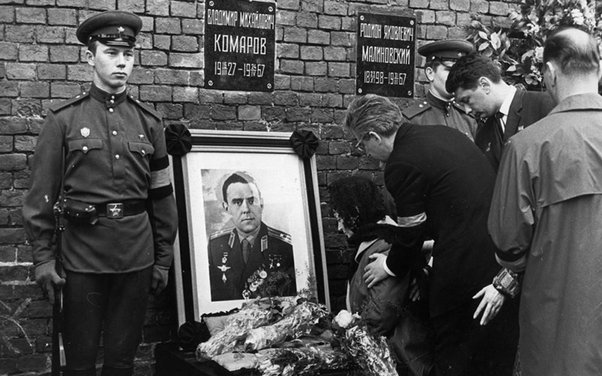
In the mid-1960s, a series of setbacks in developing a new generation of space vehicles culminated in the death of the Soviet cosmonaut Vladimir Komarov. This gave an excuse to the top Soviet rulers to redirect resources from the Moon race to less expensive programs with much more tangible military-industrial significance. Below, Komarov’s family at the entombment of the cosmonaut’s ashes in the Kremlin wall.