In older aircraft the engines were hung on pylons that extended downwards. It was designed like that for a reason. If you were to place the engines too close to the wing, it drastically affects the air flow over the wings. But fixing the engines on a long pylon solved the problem.
Firstly, the pylon ensures that the engine is not too close to the wing and most importantly the pylon when in flight sort of becomes a vortex generator. The vortex generated by the pylon adds energy to the boundary layer which then improves the stall characteristics of the aircraft.
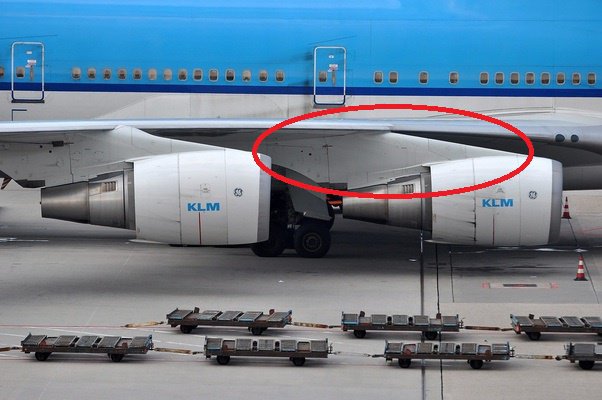
The General Electric CF-6 engines on the 747–400. Notice the long pylon.
The 747–8 has larger engines compared to the engines used by the 747–400. There are three engine options for the 747-400. They are the Pratt and Whitney PW4000, the Rolls Royce RB 211 and the General Electric CF-6.
These engines were all built in the late 70s and 80s and were second generation high bypass ratio engines. The 747–8 is fitted with new generation General Electric GEn X engines which are much larger in diameter with a higher bypass ratio than the engines used by the 747–400s.
This meant that the engines can no longer be held on long pylons as this would reduce the ground clearance. So, the engines are mounted on shorter pylons. To solve the problem with the wing boundary layer energy loss due to close fitting of engines, strakes are placed on the engine cowling.
When at high angles of attack, the strakes create a vortex and keeps the boundary layer stuck to the wings. The 747–8 is also fitted with new wings which are way more aerodynamic than the ones on the 400s. This also improves the lift characteristics of the aircraft and helps to counter the effects of close fitted engines.
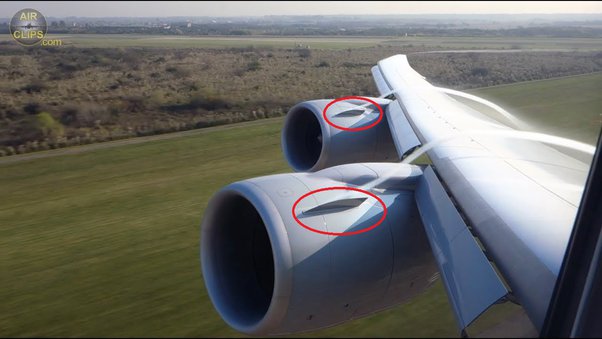
The GEn X engines which are way wider then the old engines are placed closer to the wings and they are fitted with strakes to ensure that air flow separation is minimized. In the picture, you can see the vortices generated by the starkes.